Maalin kasta, gaar ahaan magaalooyinka waaweyn, waxaa si joogto ah loo maqlaa erayga Hagbad. Waa nidaam dhaqaale oo muddo dheer ka mid ahaa nolosha bulshada Soomaaliyeed. Hooyooyin, haween, iyo asxaab ayaa isu iman jiray si ay u sameeyaan koox ay bishiiba lacag yar isku biiriyaan. Lacagtaas yar yar marka la isku daro waxay isu beddeshaa taageero weyn oo qof walba mar u baahan yahay.
Dad badan hagbadda waxay u arkaan fursad ay ku helaan lacag hal mar ah si ay u bilaabaan ganacsi, u daboolaan kharash weyn, ama u dhistaan qorshe nololeed. Si kastaba ha ahaatee, waxaa sidoo kale jira dad ka walaacsan khataraha nidaamkan, sida kalsooni darro, muran, ama lacag lumis.
Su’aasha muhiimka ah ayaa ah: Hagbaddu ma weli ku habboon tahay nolosha maanta? Mise waa in la casriyeeyaa si ay ula jaanqaado qarnigan cusub?
Maqaalkan blog-ga ah wuxuu sharxayaa waxa ay hagbaddu tahay, faa’iidooyinkeeda, dhibaatooyinka ay la kulanto, iyo sida loogu beddeli karo nidaam casri ah oo ammaan iyo hufnaan leh.
Hagbaddu waa nidaam ay koox dad ah ku heshiinayaan inay bishiiba bixiyaan lacag go’an. Lacagta la ururiyo waxaa wareeg ahaan u qaata xubnaha kooxda mid mid ilaa qof walba mar helo.
Tusaale ahaan, haddii 10 qof ay bixiyaan $50 bishiiba, lacagta la ururiyo waxay noqoneysaa $500 oo uu hal qof qaato bishii.
Hagbaddu ma aha oo kaliya hab lacag loo keydiyo. Waxay sidoo kale leedahay qiime bulsho oo weyn.
Waxay dhistaa:
Bulshada Soomaaliyeed hagbaddu waxay noqotay astaan muujinaysa sida dadka isu taageeraan marka ay jiraan baahiyo dhaqaale.
Inkasta oo ay faa’iido badan leedahay, haddana hagbaddu waxay la kulantaa caqabado dhowr ah, gaar ahaan nolosha maanta.
Nidaamka hagbadda wuxuu ku dhisan yahay kalsooni. Haddii qof ka mid ah kooxda bixin waayo lacagta ama uu ka baxo hagbadda, dhammaan kooxda ayaa saameyn ku yeelan karta.
Haddii aad ku dhacdo xaalad degdeg ah, ma heli kartid lacagtaada ilaa wareeggaagu yimaado.
Hagbadaha badankood ma laha diiwaan qoraal ah ama nidaam xisaabeed cad, taas oo keeni karta muran iyo ismaandhaaf.
Lacagta hagbadda ku jirta ma kordho mana dhaliso faa’iido. Waa kaliya hab keyd lacageed.
Si hagbadda looga dhigo mid ammaan badan oo waxtar leh, waxaa muhiim ah in lagu daro tiknolojiyadda iyo nidaamyo maaliyadeed oo casri ah.
Isticmaal apps sida WhatsApp si dhammaan xubnaha kooxda ay ula socdaan bixinta, jadwalka, iyo wararka kooxda.
Halkii aad lacag caddaan ah isu dhiiban lahaydeen, isticmaal adeegyada lacag wareejinta sida:
Tani waxay bixisaa caddayn rasmi ah oo muujinaysa in lacagta la bixiyay.
Kooxdu waxay furi kartaa akoon bangi ama mobile money ah oo gaar ah si lacagta loo kaydiyo.
Si ammaan loo helo, waxaa wanaagsan in akoonka ay maamulaan laba ama saddex qof.
Heshiiska waa inuu caddeeyaa:
Tani waxay yareynaysaa khilaaf kasta oo iman kara.
Fartuun waa gabar 28 jir ah oo doonaysa inay furto salon timo. Waxay u baahan tahay $500 si ay u iibsato qalabka shaqada.
Iyadoo aan haysan lacagtaas markiiba, waxay samaysatay hagbad 10 qof ah oo qof walba bixiyo $50 bishiiba.
Haddii nidaamka hagbadda uu yahay mid casri ah:
Tani waxay ka dhigeysaa nidaamka mid ammaan ah oo hufan.
Haddii aad rabto hagbad ammaan ah, tixgeli talooyinkan:
Dad badan waxay sameeyaan khaladaad sababa dhibaatooyin hagbadaha.
Kuwa ugu badan waxaa ka mid ah:
Ka fogaanshaha khaladaadkan waxay kaa caawin kartaa inaad ka faa’iidaysato hagbadda si sax ah.
Hagbaddu waa dhaqan dhaqaale oo qiimo badan leh oo muddo dheer ka mid ahaa nolosha Soomaalida. Waxay dadka ka caawisaa inay helaan lacag hal mar ah oo ay ku fuliyaan qorshayaal muhiim ah.
Si kastaba ha ahaatee, si ay ugu shaqeyso si ammaan ah qarnigan casriga ah, waa muhiim in lagu daro tiknolojiyadda, nidaamyo maamul, iyo heshiisyo cad.
Haddii si wanaagsan loo maareeyo, hagbaddu waxay noqon kartaa aalad awood leh oo ka caawisa dadka inay gaaraan xasillooni dhaqaale.
Hagbaddu waa nidaam dhaqaale dhaqameed oo ay Soomaalidu isticmaali jireen si ay isu taageeraan uguna keydsadaan lacag. Qof kasta oo kooxda ka tirsan wuxuu bishiiba bixiyaa lacag go’an, waxaana wareeg ahaan u qaata xubnaha kooxda. Nidaamkani wuxuu dhisayaa kalsooni iyo iskaashi bulsho, wuxuuna caawiyaa dadka inay helaan lacag badan oo hal mar ah.
Si kastaba ha ahaatee, hagbadda dhaqameed waxay la kulantaa caqabado sida kalsooni darro, khiyaano, xisaab la’aan, iyo suurtagalnimada in lacagta la waayo. Sidoo kale lacagta hagbadda ma kordho mana noqoto maalgashi.
Si nidaamkan looga dhigo mid waxtar badan qarnigan casriga ah, waxaa muhiim ah in lagu daro tiknolojiyadda sida mobile money, akoonno kooxeed, iyo heshiisyo qoran. Tani waxay ka dhigaysaa hagbadda mid ammaan ah, hufan, oo taageerta mustaqbalka maaliyadeed ee ka qayb-galayaasha.
Hagbaddu waa mid ka mid ah dhaqamada dhaqaale ee ugu caansan ee Soomaalidu muddo dheer ku dhaqmi jireen. Magaalooyinka iyo tuulooyinka labadaba, haweenka iyo qoysasku waxay isu imaan jireen si ay u sameeyaan koox hagbad ah, halkaas oo ay bishiiba lacag yar ku biiriyaan si qof kasta mar u helo lacag badan.
Habkani wuxuu ahaa mid bulshada isku xira, kalsoonina ku dhisa. Dad badan ayaa hagbadda u arkay hab sahlan oo lagu keydsado ama lagu helo lacag ay ku bilaabaan ganacsi, ku dhisaan guri, ama ku daboolaan baahi degdeg ah.
Si kastaba ha ahaatee, su’aal muhiim ah ayaa maanta la is weydiinayaa: Hagbaddu ma sii shaqayn kartaa sida ay ahayd, mise waa in la casriyeeyo?
Dhilaalo.com waxay aaminsan tahay in hagbadda ay weli leedahay qiimo weyn, laakiin ay u baahan tahay in lagu daro habab maaliyadeed oo casri ah si ay u noqoto mid ammaan ah, hufan, oo faa’iido badan.
Hagbaddu waa nidaam keyd lacageed oo koox dad ah ay sameeyaan. Kooxdu waxay ka kooban tahay tiro go’an oo xubno ah, kuwaas oo bishiiba bixiya lacag cayiman.
Tusaale ahaan haddii 10 qof ay bixiyaan $50 bishiiba, lacagta la ururiyo waxay noqoneysaa $500 oo uu hal qof qaato bishii.
Hagbaddu ma aha oo kaliya hab keyd lacageed; waa nidaam bulshada mideeya.
Waxay dhistaa:
Dhaqan ahaan, hagbaddu waxay muujinaysaa sida Soomaalidu isu garab istaagaan marka ay jiraan baahiyo dhaqaale.
Inkasta oo ay faa’iido leedahay, haddana hagbadda dhaqameed waxay la kulantaa dhibaatooyin dhowr ah.
Haddii qof bixin waayo lacagta ama baxsado, dhammaan kooxda ayaa dhibaato ku dhacda.
Lacagta hagbadda ma heli kartid ilaa wareeggaagu yimaado.
Badanaa ma jiro nidaam qoraal ama xisaab cad.
Lacagta hagbadda ma kordho, mana dhaliso faa’iido.
Si hagbadda looga dhigo mid ammaan badan, waxaa muhiim ah in la isticmaalo tiknolojiyadda.
Isticmaal WhatsApp ama Telegram si dhammaan xubnaha kooxda ay ula socdaan xogta.
Isticmaal adeegyada lacag wareejinta sida:
Tani waxay keeneysaa caddayn bixinta.
Kooxdu waxay furan kartaa akoon gaar ah oo lagu kaydiyo lacagta.
Maamulayaashu waa inay noqdaan laba ama saddex qof si looga hortago khatar.
Heshiiska waa inuu qeexaa:
Fartuun oo 28 jir ah ayaa doonaysa inay furto salon timo. Waxay u baahan tahay $500 si ay u bilowdo ganacsiga.
Waxay samaysay hagbad 10 qof ah oo qof walba bixiyo $50 bishiiba.
Haddii nidaamku yahay mid casri ah:
Tani waxay yaraynaysaa khilaaf iyo kalsooni darro.
Haddii aad rabto hagbad ammaan ah:
Qaar ka mid ah khaladaadka ugu badan waa:
Khubarada maaliyadda waxay qabaan in hagbaddu ay tahay hab fiican oo lagu dhiso caado keyd lacageed.
Laakiin waxay ku talinayaan in dadka sidoo kale ay:
Hagbaddu waa dhaqan qiimo leh oo ka tarjumaya iskaashiga bulshada Soomaaliyeed. Si kastaba ha ahaatee, si ay ugu shaqeyso si ammaan ah maanta, waa in lagu daraa nidaamyo casri ah oo maaliyadeed.
Haddii si wanaagsan loo maareeyo, hagbaddu waxay noqon kartaa qalab awood leh oo ka caawiya dadka inay gaaraan yoolalkooda dhaqaale.
If you have ever looked at your bank account at the end of the month and wondered, “Where did all my money go?”—you are not alone. There is a pervasive myth in the world of personal finance that says you need a high income to be a good saver. We are constantly fed images of wealth that involve luxury cars and sprawling homes, leading us to believe that saving money is something you do after you’ve “made it.”
But here is the truth that will change your financial life: Saving money is not about how much you earn; it is about how much you keep.
Whether you are a student living on a stipend, a freelancer with fluctuating income, or a salaried employee just starting out, the ability to save is a skill. It is a muscle that must be exercised. On a small income, every rupee saved is a victory against the tide of expenses. This guide is designed to be your playbook. We will move beyond the cliché advice of “skip your morning coffee” and dive deep into the psychology, systems, and strategies that allow ordinary people to build wealth from an ordinary income.
At Dhilaalo.com, we believe that financial education is the foundation of a free life. Let’s dismantle the barriers to saving and build a future where your money works for you, no matter how modest your paycheck is today.
Before we talk about spreadsheets and budget apps, we have to talk about your brain. Saving money on a low income is often less of a mathematical problem and more of an emotional and psychological challenge.
When we feel like we don’t have enough, our brains enter a state of “scarcity.” Psychologists call this the tunnel effect—when you are so focused on the immediate lack (the bills due tomorrow) that you lose sight of the long-term (wealth next year).
An abundance mindset isn’t about pretending you have money you don’t have. It is about recognizing that your resources—time, energy, and creativity—are abundant.
This is the single most powerful concept in personal finance, yet it is the most ignored by those with small incomes.
Traditional budgeting looks like this:
Income → Pay Bills → Spend on Wants → Save What’s Left (Usually Nothing)
“Pay Yourself First” flips the script:
Income → Save (Pay to Yourself) → Pay Bills → Spend on Wants
You might be thinking, “I have bills due tomorrow, I can’t ignore them!” The key is not ignoring bills; it is prioritizing your future self alongside your present obligations.
You have probably heard of budgeting, but have you ever performed a Lifestyle Audit? This is not about restriction; it’s about alignment. It is checking if your spending habits align with your values and goals.
You cannot manage what you do not measure. For one month, track every single expense. Use a notebook, an Excel sheet, or an app. Categories include:
Author David Bach popularized the “Latte Factor.” It’s the idea that tiny habitual expenses add up to massive wealth over time.
On a small income, impulse purchases are devastating. Implement the 24-hour rule for any non-essential item over a small amount (e.g., Rs. 500).
While stopping the chai is good, the real power in saving lies in optimizing your three largest expense categories: Housing, Transportation, and Food.
Housing is usually 30-50% of income.
A car is a depreciating asset that costs money daily (fuel, insurance, maintenance, parking).
Food is where most small-income budgets bleed the most.
A major reason people fail to save on a small income is because irregular expenses destroy their budget. You budget for monthly expenses, but then Diwali comes, or a friend’s wedding, or the annual insurance premium is due. This blows up your budget.
A sinking fund is a strategic way to save for irregular, predictable expenses. It is not an emergency fund; it is a planned expense fund.
You cannot save if you are hemorrhaging money to high-interest debt. Debt is the anchor that keeps the low-income earner from swimming to shore.
Developed by Dave Ramsey, this method focuses on behavioral wins, which are crucial when you feel financially defeated.
This is mathematically superior.
There is a hard limit to how much you can cut. You can only cut expenses so far. Eventually, you have to look at the other side of the equation: Income.
You might think, “I only save Rs. 500 a month, investing is for rich people.” Wrong.
Inflation is the silent killer of savings. If you keep your Rs. 500 under the mattress, in ten years, it will only buy Rs. 300 worth of goods. You must invest to preserve your purchasing power.
Imagine you invest Rs. 1,000 a month from age 25 to 35 (just 10 years), and then never invest another rupee again.
Background: Anjala is a 26-year-old teacher in a small city earning Rs. 25,000 per month. She lived paycheck to paycheck, often running out of money by the 25th.
The Problem: She spent heavily on eating out with friends and auto-rickshaws because she was too tired to walk or take the bus. She had no savings and Rs. 50,000 in personal loan debt from a medical emergency two years prior.
The Turnaround:
To effectively manage your money, divide your income into three metaphorical buckets, regardless of the amount:
You don’t need to wait until next month to start. Start today.
Saving money on a small income is not an oxymoron; it is a discipline.
Financial freedom is not a destination reserved for the wealthy. It is a path laid brick by brick by the disciplined. Every rupee you save is a vote for the person you want to become—a person who is secure, confident, and in control.
The fact that you are reading this, seeking knowledge, means you are already ahead of the curve. Don’t be overwhelmed by the size of the mountain; just focus on taking the first step. Your small income today is the training ground for managing the large income of tomorrow. If you cannot manage Rs. 20,000 wisely, you will not manage Rs. 2,00,000 wisely. Master the small amounts now, and the universe has a way of entrusting you with more.
Introduction
Millions of people around the world work hard every day yet still struggle financially.
They wake up early.
They go to work.
They earn money.
Yet somehow… the money disappears.
At the end of the month they ask the same question:
“Where did my money go?”
This cycle continues year after year.
Living paycheck to paycheck becomes normal.
Debt increases.
Savings never grow.
And financial stress becomes part of everyday life.
But here is the truth most people never realize:
Being broke is rarely caused by income alone.
It is usually caused by financial behavior, habits, and mindset.
Many people with high incomes still struggle financially.
Meanwhile others with modest incomes build strong financial security.
So what makes the difference?
The answer lies in how money is managed.
In this article you will learn:
By the end, you will understand exactly how to take control of your financial future.
Before fixing a financial problem, you must first understand the cause.
Most financial struggles come from a combination of five major issues.
One of the biggest problems in the world today is financial illiteracy.
Most schools teach:
But they do not teach money management.
Students graduate without learning:
Because of this, people enter adulthood unprepared for financial reality.
They learn money lessons the hard way.
Often through mistakes.
Another major reason people stay broke is lifestyle inflation.
When income increases, spending increases even faster.
For example:
A person earns $500 per month.
Later they earn $1000.
Instead of saving the extra money, they upgrade their lifestyle.
They buy:
Soon the $1000 income feels just as tight as the $500 income.
This pattern repeats again and again.
Without a budget, money has no direction.
Imagine a city without traffic rules.
Cars would crash everywhere.
The same happens with money.
Without a budget:
A budget is simply a plan for your money.
Yet most people never create one.
Debt is one of the biggest obstacles to financial freedom.
Common types include:
The problem with debt is that it steals future income.
Instead of money working for you, you work to pay interest.
Over time this creates a financial trap.
Money habits start in the mind.
If someone believes:
Then their actions will reflect those beliefs.
A strong financial mindset is critical for long-term success.
Now that we understand the problem, let’s look at the solution.
A simple 5-step financial system can transform your financial life.
The first step is awareness.
You must know exactly:
Start tracking expenses such as:
Many people are shocked when they see their real spending habits.
Tracking money creates financial clarity.
A budget tells your money where to go.
One of the simplest systems is the 50/30/20 rule.
Essential expenses:
Lifestyle spending:
This structure helps maintain financial balance.
Unexpected expenses are guaranteed.
Examples include:
Without savings, people rely on debt.
An emergency fund protects you from financial disasters.
Start with:
High interest debt destroys wealth.
Prioritize paying off:
Two effective strategies include:
Pay off the smallest debt first.
This creates motivation and quick wins.
Pay off the highest interest debt first.
This saves the most money long term.
Saving money is good.
Investing money is better.
Investing allows your money to grow through compound interest.
For example:
If you invest $100 monthly for 20 years, the growth can be significant.
Time is the most powerful factor in investing.
The earlier you start, the better.
Consider two friends.
Earns $800 monthly.
He:
Earns $1200 monthly.
But he:
After 10 years:
Ahmed has strong savings.
Hassan still struggles financially.
Income alone does not determine wealth.
Financial behavior does.
Many people sabotage their finances through small mistakes.
Examples include:
Avoiding these mistakes can dramatically improve your financial future.
Successful people often follow consistent money habits.
Examples include:
Save money immediately after receiving income.
Review expenses weekly.
Increase savings when income increases.
Financial education should be continuous.
Wealth building requires patience.
Important principles include:
Small actions repeated over time produce powerful results.
Here is a simple action plan.
Track all expenses.
Create a personal budget.
Start an emergency fund.
Begin investing.
Small steps lead to major financial change.
Let’s recap the most important ideas.
Most people stay broke because of:
But the solution is simple.
Follow this system:
Financial freedom is not about luck.
It is about knowledge, discipline, and smart decisions.
Anyone can improve their financial situation by learning the right strategies.
Even small improvements today can create massive results in the future.
If you want to master:
Visit Dhilaalo.com for more financial education resources designed to help you build a better financial future.
Your journey to financial freedom starts with knowledge and action.
Start today.
Baro 10 xeelado dhaqaale oo wax ku ool ah oo kaa caawinaya inaad si xikmad leh u maareyso kharashaadka Ramadan, u qorshayso zakada, u kaydsato Ciidda, una dhisto mustaqbal maaliyadeed oo xasilloon.
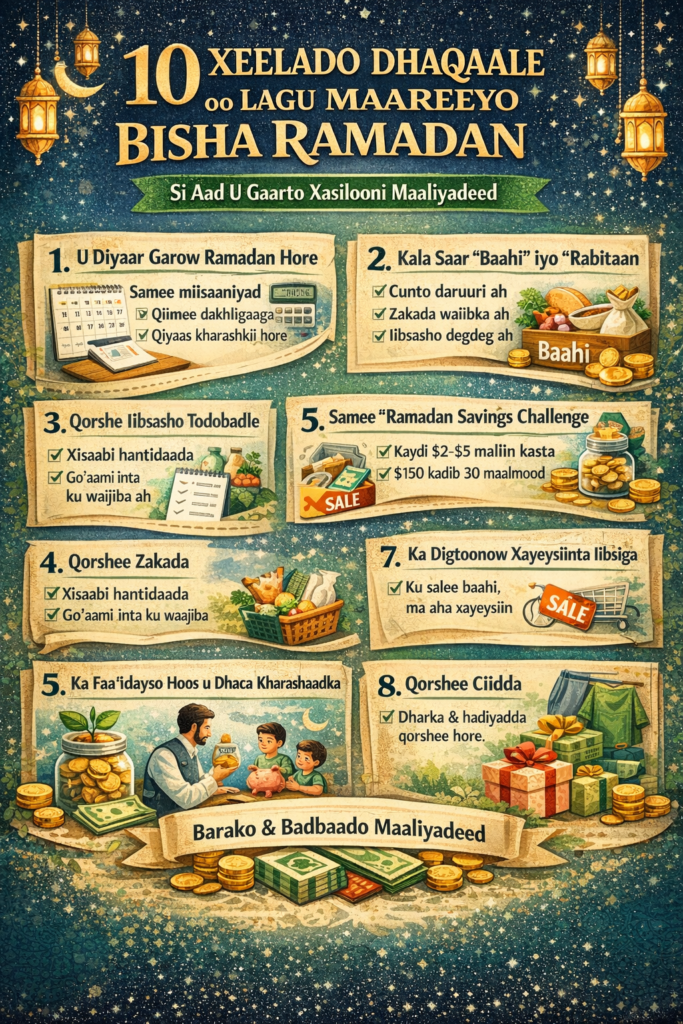
Dad badan waxay u arkaan Ramadan bil kharash oo keliya. Laakiin marka si cilmi iyo qorshe leh loo eego, Ramadan waa fursad dahabi ah oo lagu hagaajin karo dhaqaalaha qoyska.
Anigoo ku hadlaya aragti dhaqaale oo qoto dheer, waxaan kuu soo bandhigayaa xeelado aad ku maareyn karto lacagtaada si aad uga baxdo bisha adigoo:
Qorshaha wanaagsan ma bilaabmo maalinta 1-aad ee Ramadan – wuxuu bilaabmaa ugu yaraan 30 maalmood ka hor.
Samee:
Khaladka ugu weyn waa in la isku qaldo baahida iyo rabitaanka.
Baahi:
Rabitaan:
Qofka dhaqaale yaqaan wuxuu rabitaanka ka hormariyaa baahida.
Ha u dukaameysan si maalinle ah adigoo aan qorshe lahayn.
Samee:
Tani waxay yaraynaysaa:
Zakadu waa tiir dhaqaale iyo mid diini ah.
Si xeeladaysan u samee:
Qorshaynta zakada waxay ka hortagtaa culays maalmaha ugu dambeeya.
Ramadan gudaheeda:
Fursad ka dhig inaad kaydsato lacagtaas halkii aad ku bixin lahayd meel kale.
Tusaale:
Lacagtaas waxaad u isticmaali kartaa:
Ganacsiyadu waxay kordhiyaan xayeysiinta Ramadan.
Maskaxda ku hay:
Iibsiga ku salee baahi, ma aha xayeysiin.
Qorshaha Ciidda:
Tani waxay yaraynaysaa qiimo kordhin iyo cadaadis.
Ramadan waa waqti ku habboon in carruurta lagu baro:
Dhaqan dhaqaale oo wanaagsan wuxuu ka bilaabmaa guriga.
Is weydii:
Qiimeyntu waa furaha horumar dhaqaale.
Ramadan ma aha oo kaliya bil cibaado; waa bil lagu dhiso edbin dhaqaale.
Qofka:
Wuxuu ka baxaa bisha isagoo dhaqaale ahaan ka xoog badan sidii hore.

—
16. Behavioral Finance: How Your Mind Affects Money Decisions.
Money Is Emotional Before It Is Logical
Many people think financial decisions are purely about numbers and calculations. In reality, emotions play a major role in how people manage money.
The most common emotions that damage financial progress are:
Fear
Impatience
Greed
Comparison
Regret
People who build long-term wealth are not smarter—they are better at controlling emotions.
—
17. Common Financial Mistakes Most People Make
1. Making Decisions Too Quickly
Impulse spending, rushed investments, and unplanned loans often lead to regret.
Solution:
Give yourself time. Even waiting 24 hours can prevent bad decisions.
—
2. Relying on Only One Source of Income
When your income depends on a single source, your financial stability is fragile.
Solution:
Consider:
Side income
Small businesses
Investments
Digital skills
—
3. Fear of Starting
Many people delay financial action while waiting for the “perfect time.”
Truth:
The best time to start improving your finances is now.
—
18. The Importance of Side Income
Why Side Income Matters
Side income:
Reduces financial pressure
Increases flexibility
Accelerates wealth-building
Even small, consistent extra income can make a huge difference over time.
Examples of Side Income
Freelancing
Blogging
Online teaching
E-commerce
Content creation
—
19. Managing Money When Income Increases
Higher Income Does Not Equal Wealth
Many people increase spending as soon as their income rises.
Wealth builders follow a different rule:
1. Increase savings first
2. Increase investments second
3. Improve lifestyle last
—
20. The Importance of Financial Goals
Without Goals, Money Disappears
Money without direction gets wasted.
Effective financial goals are:
Clear
Measurable
Time-based
Example: ❌ “I want more money”
✅ “I want to save $10,000 within three years”
—
21. Separating Needs From Wants
Needs vs. Wants
Needs include:
Food
Shelter
Healthcare
Education
Wants include:
Luxury items
Expensive upgrades
Non-essential entertainment
Long-term wealth comes from prioritizing needs before wants.
—
22. Family, Environment, and Financial Influence
Your Environment Shapes Your Financial Behavior
If you are surrounded by people who:
Overspend
Avoid planning
Mock saving
Financial progress becomes harder.
Solution:
Surround yourself with people who value:
Growth
Discipline
Long-term thinking
—
23. The Power of Patience
Patience Is a Financial Asset
Wealth does not appear in:
One month
One year
One decision
It grows through:
Time
Consistency
Patience
—
24. Investment Mistakes to Avoid
Avoid:
Investing in things you don’t understand
Following others blindly
Chasing quick profits
Selling during market fear
Successful investors:
Stay calm
Think long-term
Trust their plan
—
25. Automating Your Financial System
Why Automation Works
Automation removes emotion and inconsistency.
You can automate:
Savings
Investments
Bill payments
This creates:
Fewer mistakes
Better discipline
Lower stress
—
26. Building Generational Wealth
What Is Generational Wealth?
Generational wealth is financial security that:
Lasts beyond your lifetime
Supports your children and family
Creates long-term opportunity
It requires:
Planning
Education
Responsible habits
—
27. Risk Management and Future Planning
Lack of Planning Is the Biggest Risk
Life is unpredictable.
A strong financial plan prepares for:
Health emergencies
Job loss
Economic changes
Preparation protects progress.
—
28. One Smart Decision Every Day
Small Decisions Create Big Change
You don’t need to change everything at once.
Start with:
One habit
One saving goal
One improvement
Consistency matters more than perfection.
—
Conclusion (Part 2)
Long-term wealth is not built through luck or sudden success. It is built through daily financial decisions, emotional control, patience, and discipline.
Anyone—regardless of current income—can move toward financial stability and freedom by making smarter choices every day.
—

Practical Money Skills for Budgeting, Saving, Investing & Financial Freedom|
By Dhilaalo.com
Introduction:
Why Personal Finance Matters More Than Ever.
In today’s fast-changing world, personal finance is no longer a topic reserved for economists, bankers, or wealthy investors. It has become a daily survival skill for everyday people. From managing monthly expenses to planning long-term financial security, understanding how money works directly affects the quality of our lives.
Rising living costs, unstable global markets, inflation, digital currencies, and online financial tools have changed how people earn, spend, save, and invest money. Many people work hard every day, yet still struggle financially—not because they don’t earn enough, but because they were never taught how to manage money intelligently.
This guide was created to solve that problem.
At Dhilaalo.com, we believe personal finance should be simple, practical, and accessible to everyone—regardless of income level, education, or background. This article breaks down complex financial concepts into clear, real-world strategies that everyday people can apply immediately.
By the end of this guide, you will understand:
How to control your money instead of chasing it
How to build a realistic budget that actually works
How to save consistently, even on a low income
How investing works and how beginners can start safely
How to reduce financial stress and move toward long-term freedom
1. Understanding Personal Finance: The Foundation
Personal finance is the management of an individual’s or household’s money.
It includes:
Income management
Spending decisions
Saving habits
Investing strategies
Risk protection (insurance & emergency planning)
At its core, personal finance answers one key question:
How do I make my money work for me instead of working forever for money?
The Five Pillars of Personal Finance
Income
Budgeting
Saving
Investing
Financial Protection & Planning
Ignoring even one of these pillars creates financial instability.
2. Budgeting: Taking Control of Your Money
What Is a Budget?
A budget is a plan for your money, not a punishment. It tells your money where to go instead of wondering where it went.
Why Most Budgets Fail
Unrealistic expectations
Over-restriction
No flexibility
No tracking system
The 50/30/20 Rule (Beginner Friendly)
50% → Needs (rent, food, bills)
30% → Wants (entertainment, lifestyle)
20% → Savings & investments
If your income is low, adjust the percentages—but always save something.
Zero-Based Budgeting
Every dollar is assigned a job: Income − Expenses − Savings = 0
This method gives maximum control and awareness.
3. Saving Money: Building Financial Security
Why Saving Is Non-Negotiable
Savings protect you from:
Emergencies
Debt traps
Financial stress
Poor decisions under pressure
Emergency Fund
Your first goal:
3–6 months of living expenses
Kept in an accessible account
Used only for real emergencies
Saving on a Low Income
Save before spending
Automate savings
Start small (even $1/day matters)
Increase savings when income increases
Consistency matters more than amount.
4. Debt Management: Escaping the Debt Cycle
Good Debt vs Bad Debt
Good Debt
Education
Business
Income-producing assets
Bad Debt
High-interest consumer debt
Credit cards for lifestyle spending
Debt Snowball Method
Pay smallest debt first
Gain motivation
Roll payments forward
Debt Avalanche Method
Pay highest interest first
Saves more money long-term
Choose the method that keeps you consistent.
5. Investing: Making Money Grow Over Time
What Is Investing?
Investing means putting money into assets that grow in value or generate income over time.
Why Investing Is Essential
Saving protects money. Investing multiplies money.
Beginner Investment Options
Index funds
Mutual funds
Stocks
Real estate
Bonds
ETFs
Digital assets (with caution)
Power of Compound Interest
Money grows faster when profits are reinvested.
Time in the market beats timing the market.
6. Personal Finance in the Digital Age
Online Banking & Fintech
Mobile banking
Budgeting apps
Investment platforms
Crypto exchanges
Benefits
Accessibility
Transparency
Speed
Automation
Risks
Scams
Over-trading
Lack of regulation
Financial education is your best protection.
7. Building Multiple Income Streams
Relying on one income source is risky.
Common Income Streams
Salary
Freelancing
Online businesses
Investments
Digital content
Passive income assets
Multiple streams increase financial stability.
8. Financial Freedom: What It Really Means
Financial freedom does not mean being rich. It means:
Freedom of choice
Reduced stress
Control over time
Ability to handle emergencies
Steps Toward Financial Freedom
Control spending
Eliminate bad debt
Build savings
Invest consistently
Increase income
Protect assets
9. Common Personal Finance Mistakes
Living without a budget
Ignoring savings
Emotional spending
Chasing quick profits
Avoiding financial education
Awareness is the first step to correction.
10. Personal Finance for Everyday People (Reality-Based Advice)
This guide is not about luxury lifestyles. It is about:
Practical decisions
Small consistent actions
Long-term thinking
You don’t need to be rich to manage money well. You need discipline, knowledge, and patience.
Conclusion: Take Control of Your Financial Future
Personal finance is not about perfection. It is about progress.
Every small step you take today creates a stronger financial future tomorrow. Whether you are just starting or rebuilding, the most important step is starting now.
At Dhilaalo.com, our mission is to make financial knowledge accessible, practical, and empowering for everyday people.
Your money journey starts with understanding—and this guide is your first step.
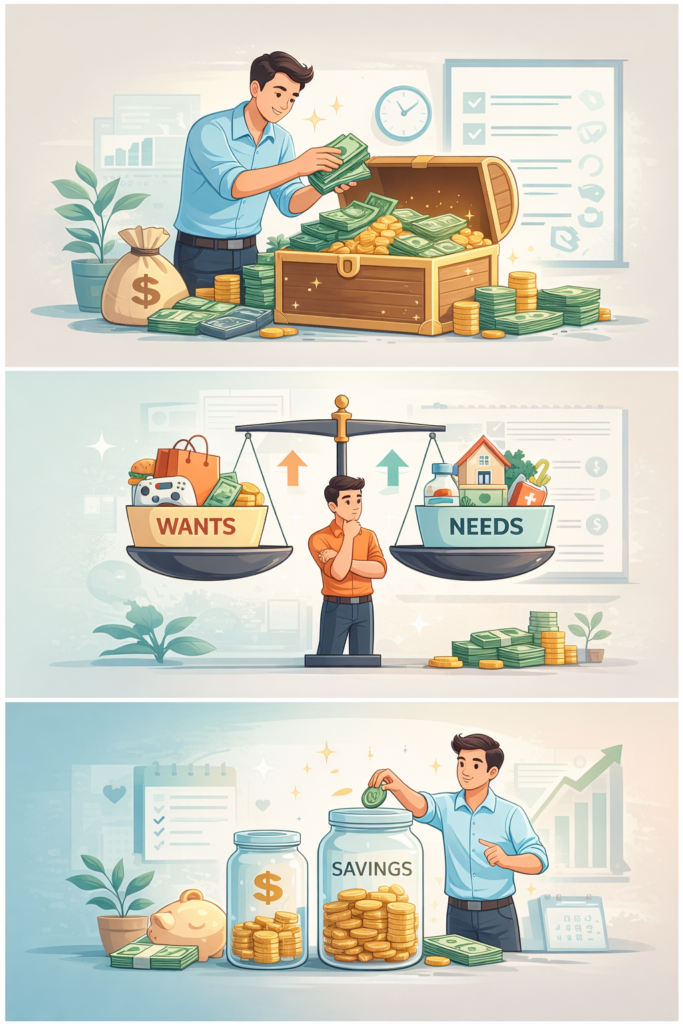
Most people believe that wealth is created through big moments—landing a high-paying job, starting a successful business, or making a lucky investment. In reality, long-term wealth is built through small, everyday financial decisions repeated consistently over time.
Every choice you make about money—how you spend, save, borrow, invest, and protect it—shapes your financial future. These decisions may seem insignificant on a daily basis, but when combined over months and years, they determine whether you struggle financially or build lasting wealth.
This article is written for everyday people. You do not need to be wealthy, highly educated, or financially experienced. You only need awareness, discipline, and a willingness to improve one decision at a time.
—
1. Understanding Wealth as a Process, Not a Destination
Wealth Is Built Slowly
True wealth does not happen overnight. It is the result of:
Consistent habits
Long-term thinking
Patience
Discipline
People who chase quick money often lose it just as fast. Those who focus on systems and habits tend to build sustainable wealth.
Financial Freedom vs. Richness
Being wealthy does not always mean being rich. Financial freedom means:
You can meet your needs comfortably
You are not constantly stressed about money
You have options and flexibility
Your money supports your life goals
Everyday financial decisions are what move you toward that freedom.
—
2. The Power of Daily Spending Decisions
Small Expenses Matter More Than You Think
Many people ignore small daily expenses:
Coffee
Snacks
Subscriptions
Impulse purchases
While each cost may be small, together they can drain thousands of dollars annually.
Wealthy individuals are not cheap—they are intentional.
Conscious Spending
Ask yourself:
Do I need this?
Does this align with my goals?
Is this a habit or a choice?
Controlling spending does not mean suffering. It means directing money toward what truly matters.
—
3. Budgeting as a Tool for Control, Not Restriction
Why Budgeting Is Essential
A budget is not a punishment. It is a plan.
Budgeting helps you:
Understand where your money goes
Prevent overspending
Save intentionally
Reduce stress
Make confident decisions
People who avoid budgeting often feel confused and anxious about money.
Simple Budget Structure
A basic budget includes:
Income
Fixed expenses
Variable expenses
Savings
Investments
You do not need complex spreadsheets. Clarity is more important than perfection.
—
4. Saving: The Foundation of Financial Security
Why Saving Comes Before Investing
Saving provides:
Emergency protection
Stability
Confidence
Without savings, one unexpected expense can destroy progress.
Emergency Funds
An emergency fund should cover:
3–6 months of living expenses
Medical emergencies
Job loss
Unexpected repairs
This fund is not for luxury—it is for survival and peace of mind.
—
5. The Psychological Impact of Financial Stability
Reduced Stress
People with savings:
Sleep better
Make clearer decisions
Take fewer emotional risks
Financial stress affects:
Health
Relationships
Productivity
Mental well-being
Everyday saving decisions protect more than your money—they protect your life quality.
—
6. Managing Debt Wisely
Not All Debt Is Equal
There are two main types:
Bad debt (high interest, consumer debt)
Strategic debt (education, business, assets)
Uncontrolled debt destroys wealth slowly.
Everyday Debt Decisions
Ask:
Is this debt necessary?
Can I afford the repayments?
What is the interest cost over time?
Avoid debt that does not increase your long-term value.
—
7. Investing as a Long-Term Habit
Investing Is Not Gambling
True investing is:
Long-term
Diversified
Patient
Based on fundamentals
Short-term speculation often leads to losses.
Start Small
You do not need large capital to begin investing. The habit matters more than the amount.
Consistent investing builds wealth through compounding.
—
8. Compounding: The Hidden Force Behind Wealth
Time Is Your Greatest Asset
Compounding means:
Your money earns returns
Those returns earn returns
Growth accelerates over time
The earlier you start, the more powerful compounding becomes.
Even small amounts grow significantly with time and consistency.
—
9. Protecting Wealth Through Risk Management
Why Protection Matters
Wealth is not only about growth—it is also about protection.
Unexpected events can destroy years of effort without preparation.
Insurance and Planning
Basic protection includes:
Health insurance
Life insurance (if you have dependents)
Emergency planning
Protection allows wealth to survive crises.
—
10. Financial Discipline and Consistency
Motivation Fades, Discipline Lasts
Most people fail financially not due to lack of knowledge, but due to lack of discipline.
Daily discipline includes:
Tracking spending
Saving regularly
Avoiding emotional decisions
Staying focused on long-term goals
Small disciplined actions create big results.
—
11. Aligning Money With Life Goals
Money Is a Tool, Not the Goal
Ask:
What kind of life do I want?
What does financial success mean to me?
When money aligns with purpose, decisions become clearer and easier.
—
12. Avoiding Lifestyle Inflation
The Silent Wealth Killer
As income increases, many people increase spending immediately.
True wealth builders:
Increase savings first
Invest the difference
Maintain controlled lifestyles
Lifestyle inflation keeps people broke despite higher income.
—
13. Learning Financial Literacy Continuously
Knowledge Protects Wealth
Financial education helps you:
Avoid scams
Make better decisions
Adapt to change
Use tools wisely
Learning should be ongoing, not one-time.
—
14. Technology and Smart Financial Tools
Use Tools, Don’t Depend on Them
Apps and platforms help with:
Tracking
Automation
Analysis
But understanding fundamentals is more important than tools.
—
15. Building Wealth With Patience
Wealth Takes Time
Most overnight success stories hide years of effort.
Consistency beats intensity.
Focus on progress, not perfection.
—
Conclusion (Part 1)
Long-term wealth is built through everyday financial decisions, not rare opportunities. Each small choice either moves you closer to or further from financial freedom.
By controlling spending, saving consistently, managing debt wisely, investing patiently, and protecting your resources, you build a system that supports long-term success.
—
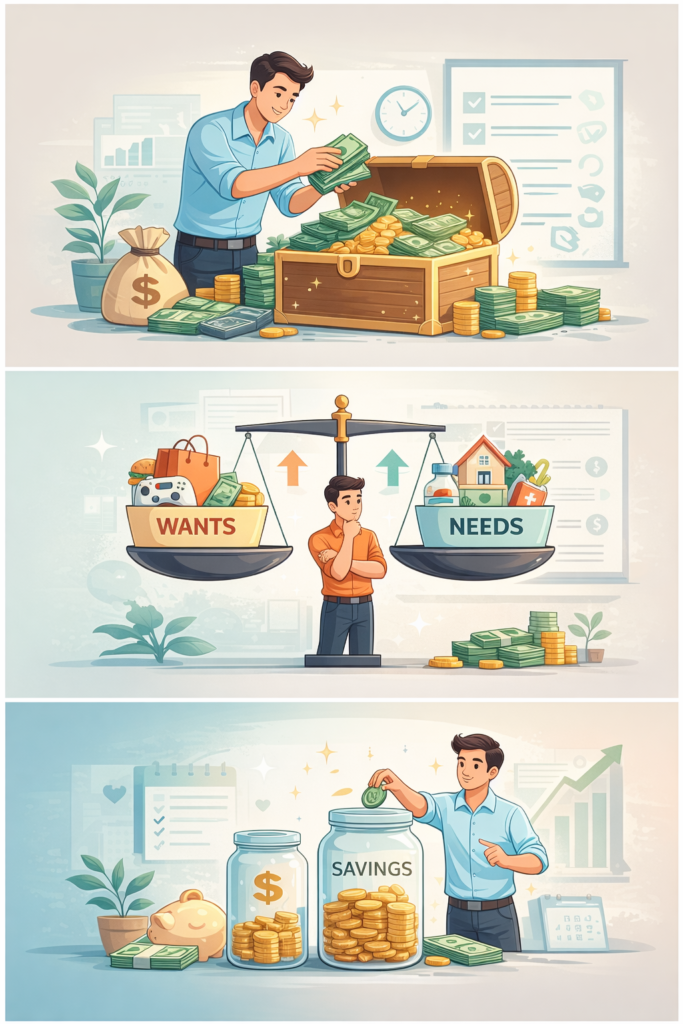
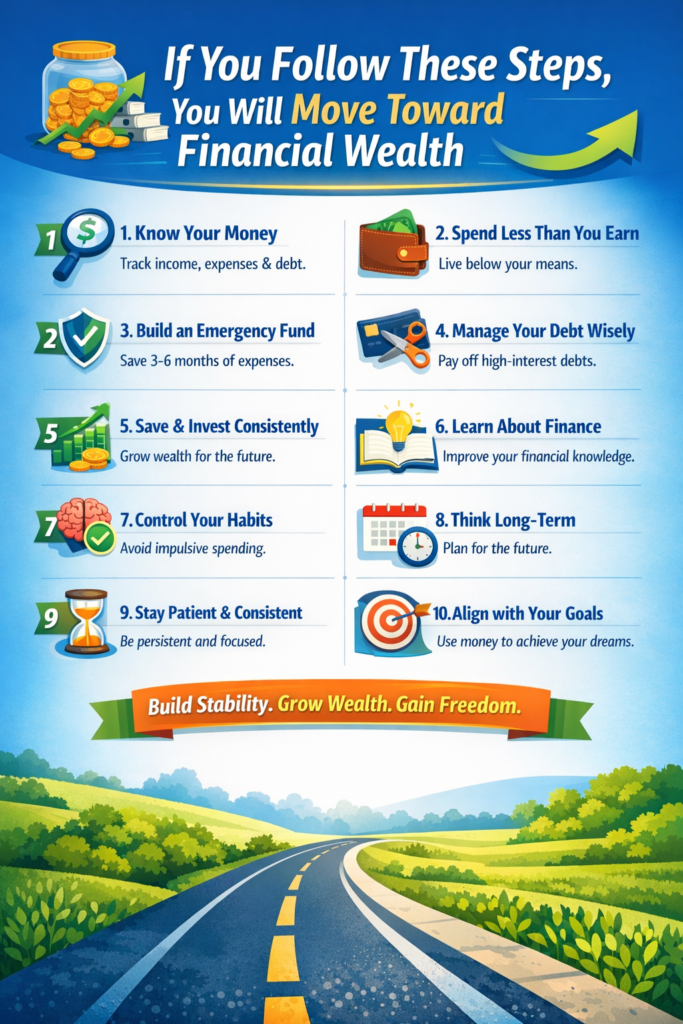
Financial wealth is not something that happens overnight. It is not a result of luck, inheritance, or secret knowledge known only by a few people. Financial wealth is built through clear understanding, disciplined behavior, and consistent action over time.
Many people work hard their entire lives yet remain financially stressed. Others, with similar or even lower income, manage to build stability, freedom, and wealth. The difference is not income alone—it is how money is managed.
This article explains, in clear and practical terms, the steps that help everyday people move toward financial wealth. These steps are not shortcuts. They are proven principles that work across countries, cultures, and income levels.
Before discussing steps, it is important to clarify what financial wealth actually is.
Financial wealth does not simply mean being rich. It means:
True financial wealth combines stability, security, and growth. It allows you to live with confidence today while preparing for tomorrow.
The journey toward financial wealth always begins with awareness.
Many people avoid looking closely at their finances because it feels uncomfortable. They do not track expenses, review income, or calculate debt. This lack of awareness creates confusion and poor decision-making.
Financial awareness means knowing:
When you understand these things clearly, money stops being a mystery and becomes a tool.
Without awareness:
With awareness:
Awareness does not require perfection—it requires honesty.
Spending less than you earn is the foundation of financial wealth. No amount of investing or financial knowledge can compensate for consistently spending more than income.
This principle sounds simple, but it requires discipline and planning.
Living within your means does not mean living poorly. It means:
When expenses are controlled, money begins to work for you instead of against you.
A budget is not a restriction—it is a plan. It tells your money where to go instead of wondering where it went.
A good budget:
Budgeting is not about cutting joy—it is about protecting your future.
One of the biggest reasons people fall into debt is unexpected expenses.
Emergencies are not rare events. They are part of life:
An emergency fund is money set aside specifically to handle these situations.
Without an emergency fund:
With an emergency fund:
Even saving a small amount consistently builds protection over time.
Debt is not always bad, but unmanaged debt is dangerous.
High-interest debt, emotional borrowing, and unnecessary loans prevent wealth creation. They drain income and limit flexibility.
Not all debt is equal:
The goal is not to fear debt, but to control it.
Reducing debt increases cash flow, confidence, and freedom.
Saving is the bridge between income and security.
Many people wait to save “when income increases.” In reality, saving should start immediately—even in small amounts.
Saving consistently:
Saving is not about how much you start with—it is about continuing.
Savings can serve different purposes:
Each type supports financial peace and resilience.
Saving protects money, but investing grows it.
Investing allows money to work for you over time through compounding. Wealth is rarely built through sudden gains—it is built through patient growth.
Investment success depends more on discipline than intelligence.
The earlier you invest, the more time works in your favor. Compounding rewards patience and consistency.
Financial education is a lifelong process.
The financial world changes:
People who continue learning avoid common mistakes and adapt more easily.
You do not need to be an expert. You need to understand the basics well.
Money decisions are often emotional, not logical.
Fear, excitement, pressure, and comparison lead to poor financial choices. Behavioral discipline is one of the strongest predictors of financial success.
Emotional control protects long-term goals.
Financial wealth is not built quickly.
Short-term thinking leads to:
Long-term thinking encourages:
Progress may feel slow, but consistency compounds results.
Money is a tool—not a purpose.
Financial wealth becomes meaningful when aligned with life goals such as:
When money serves clear goals, motivation increases and discipline strengthens.
These steps work because they:
Financial wealth is accessible to anyone willing to practice discipline and patience.
Understanding mistakes helps avoid them:
Avoiding these mistakes accelerates progress.
There is no final moment where financial learning ends. Wealth is maintained through:
Each step builds on the previous one.
If you follow these steps, you will move toward financial wealth.
The journey requires effort, patience, and consistency—but it is achievable. Financial wealth is not about perfection. It is about direction.
By understanding money, managing behavior, planning for the future, and staying disciplined, anyone can build financial stability and long-term wealth.
Have you ever wondered why some people seem to build wealth effortlessly while others struggle financially despite earning the same income? The answer often isn’t income—it’s habits. Small daily decisions, repeated over time, can either create financial freedom or trap you in debt and missed opportunities.
In this post, we’ll explore three of the most common dangerous financial habits and how to break them.
Overspending is one of the most destructive financial habits. At first, it may seem harmless, but consistently spending more than you earn or failing to plan expenses can slowly erode wealth. People who overspend often live paycheck to paycheck—even with a decent salary.
Psychologists define overspending as spending driven by emotions or social pressures, not necessity. One splurge is fine, but consistent overspending—especially on non-essential items—creates a silent financial drain over time.
Fact: Over 60% of Americans admit to spending money they don’t have on unnecessary purchases, leading to an average credit card debt of $6,000 per household.
Why do people overspend?
Tip: Keep a spending journal for 30 days. Track every purchase, why you made it, and how it made you feel. Awareness is the first step toward change.
Neglecting savings is a silent financial killer. Without a cushion, emergencies—like medical bills, car repairs, or job loss—can spiral into debt and stress.
Statistic: Nearly 40% of Americans cannot cover a $400 emergency without borrowing.
Ignoring savings also limits opportunities for investment, education, or business ventures. Every day spent not saving is a missed opportunity to grow wealth.
Social and cultural pressures to spend rather than save also make it difficult to prioritize financial security.
Starting to save early allows your money to grow exponentially through compound interest.
Example:
The 10-year head start almost doubles Sarah’s savings.
Psychological Benefits: Reduces stress, creates control, and enables flexibility for opportunities.
Credit is a tool—but overreliance can destroy wealth. Many people use credit cards, loans, or buy-now-pay-later schemes to maintain lifestyles beyond their means. Over time, high-interest debt mounts, limiting financial growth.
Fact: The average American credit card debt is $5,000, with 40% carrying balances month-to-month.
Excessive credit use often hides a deeper problem: lack of budgeting and discipline. The “buy now, pay later” mindset creates an illusion of security while debt quietly accumulates.
Example: $10,000 credit card debt at 20% interest → $20,000 lost in 10 years if unpaid.
Case Study: Michael had $25,000 credit card debt → eliminated in 3 years using strict budgeting → invested savings → net worth $100,000 by 35.
✅ Key Takeaways from These 3 Habits
Breaking these habits is not about income—it’s about behavior, awareness, and discipline. Small changes today compound into massive financial results tomorrow.