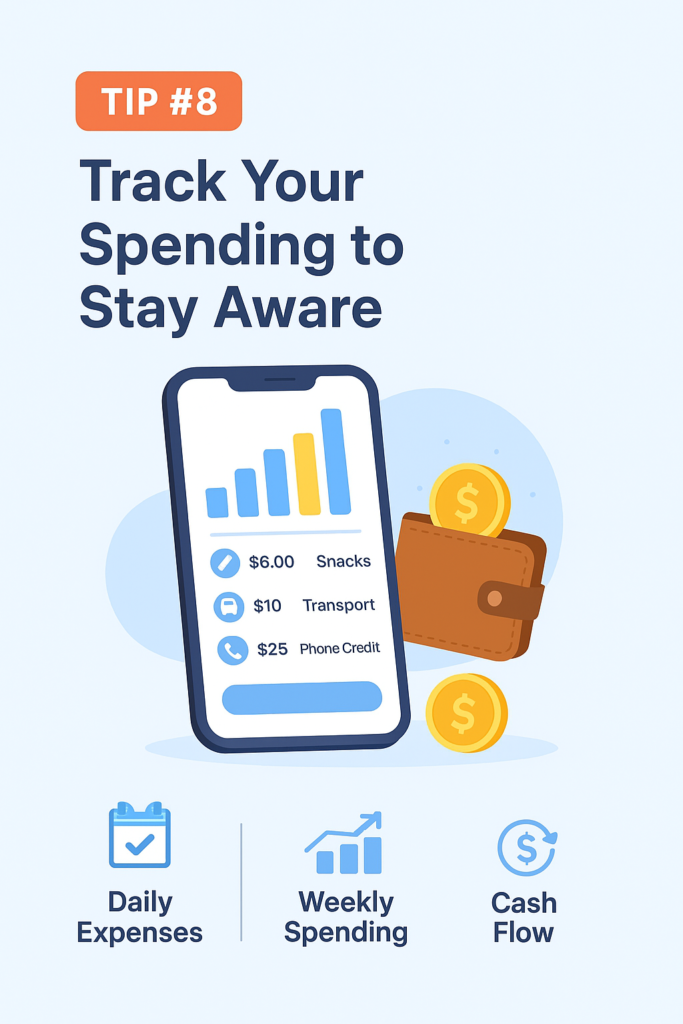
Simple Tracking = Smarter Decisions + Stronger Financial Control
—
Introduction: Why Tracking Your Spending Matters
Most people don’t realize where their money goes each month. They know they spend “a lot,” but they don’t know exactly how much or on what categories. Tracking your spending gives you the clarity you need to make better financial decisions, reduce waste, and build long-term wealth. It is one of the simplest habits with the biggest impact.
—
What It Means to Track Your Spending
Tracking your spending means recording every expense you make—whether big or small—so you can understand your financial patterns. It helps you see:
How much money goes to essentials
How much is wasted on unnecessary spending
Where you can cut back to save more
How your daily choices affect your monthly financial health
The goal is not to restrict your life, but to gain control.
—
Why Tracking Expenses Is the Foundation of Financial Success
1. It Increases Your Financial Awareness
When you see every dollar you spend, you become more mindful. You stop buying things without thinking.
2. It Helps You Identify Bad Spending Habits
Small purchases add up quickly. Tracking expenses reveals patterns you never noticed.
3. It Allows You to Create a Realistic Budget
You cannot build an effective budget without first knowing your true spending habits.
4. It Helps You Set Achievable Financial Goals
Saving for an emergency fund, paying off debt, or investing becomes easier when you know exactly how much money you can allocate.
5. It Reduces Stress
Financial stress usually comes from uncertainty. When everything is tracked and clear, you gain peace of mind.
—
How to Start Tracking Your Spending
1. Choose a Tracking Method
Pick one that fits your lifestyle:
Finance apps (Mint, PocketGuard, YNAB, etc.)
A simple Excel or Google Sheet
A notebook you update every day
Bank statements + manual categorization
2. Track Every Expense Daily
Write down or record everything:
Food
Transport
Bills
Entertainment
Savings
Subscriptions
Consistency is more important than perfection.
3. Categorize Your Spending
Group your expenses so patterns become easy to see:
Essentials (rent, groceries, utilities)
Non-essentials (eating out, clothing, hobbies)
Financial growth (savings, investments, debt)
4. Review Weekly or Monthly
Ask yourself:
Where did most of my money go?
What spending category surprised me?
What can I reduce next month?
Did I move closer to my financial goals?
—
Tips to Stay Consistent
Use apps that track automatically
Set reminders on your phone
Review your expenses at the same time each day
Keep the process simple—don’t overcomplicate
Reward yourself when you meet monthly goals
—
How Tracking Spending Helps With Long-Term Wealth
When you track your expenses over months and years, you begin to understand your financial behavior deeply. This leads to:
Higher savings rate
Faster debt payoff
Easier emergency fund building
Better investment opportunities
Increased financial confidence
Small daily habits create big long-term results.
—
Conclusion
Tracking your spending is not difficult, but it is one of the most powerful financial habits you can build. It gives you clarity, control, and confidence—three essential ingredients for financial freedom. Start today with whatever method feels simplest, and in just a few weeks, you’ll see a major shift in how you spend, save, and manage your money.
—
Introduction
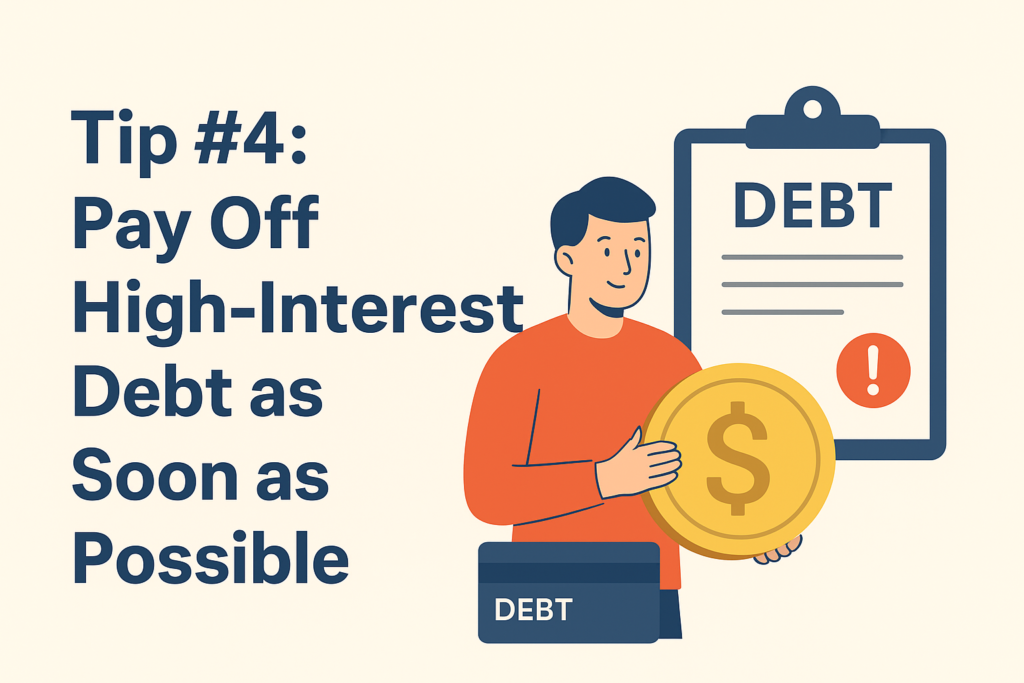
Many people who start their personal finance journey focus on saving money, investing early, or increasing their income. All these things are great—but none of them matter if you’re still trapped under high-interest debt. Debt with a high interest rate acts like a silent financial drain that slowly eats away your savings, future investments, and monthly budget.
If you don’t prioritize paying it off, high-interest debt keeps growing on its own. It makes it nearly impossible to build wealth because the money you should be saving or investing ends up going toward interest instead of your actual balance.
Paying off high-interest debt isn’t just a financial step—it’s the foundation that makes saving, investing, and long-term planning possible.
—
Section 1: What Counts as High-Interest Debt?
High-interest debt is any debt that charges 10%–15% interest or more. But typically, financial experts consider anything above 18% as high-risk debt that must be paid off immediately.
Common examples include:
Credit card debt (15%–35%)
Online loans or micro-loans (20%–200% APR)
Buy Now Pay Later loans with hidden fees
Bank overdraft penalties and interest
Store financing (electronics, furniture, appliances)
Emergency loans from loan apps
The biggest problem with this type of debt is not the amount you borrowed—
it’s the compound interest that grows month after month.
—
Section 2: Why High-Interest Debt Is a Financial Emergency
1. It destroys your ability to save
If you pay $70–$100 a month in interest, that’s $840–$1,200 a year completely wasted.
This money could have gone into:
Savings
Investments
Emergency fund
Education or business
Interest is money you get nothing for.
—
2. It keeps you living paycheck-to-paycheck
The more debt payments you have, the tighter your budget becomes.
This makes it harder to build any financial stability or flexibility.
—
3. It lowers your credit score
High debt utilization and late payments cause:
Lower credit score
Higher loan interest in the future
Reduced approval chances for rentals or financing
Debt affects more than your wallet—it affects your opportunities.
—
4. It blocks your ability to invest
There is no point making a 10% profit from investments when you are losing 25% in debt interest.
You are always behind.
—
5. It increases stress and mental pressure
High-interest debt is one of the biggest causes of:
Anxiety
Sleepless nights
Relationship conflict
Financial insecurity
Paying it off brings peace of mind as much as it brings financial freedom.
—
Section 3: Step-by-Step Plan to Pay Off High-Interest Debt
Step 1: Get a full picture of your debt
Write down:
Total debt amount
Interest rate (%)
Minimum monthly payment
Due dates
Lender name
You cannot fix what you do not understand.
—
Step 2: Prioritize your debts
Sort your debts into three levels:
High-interest (top priority)
Medium-interest
Low-interest
Anything above 15% should be dealt with immediately.
—
Step 3: Choose Your Payment Strategy
Strategy A: Avalanche Method (Fastest & most efficient)
Pay off the highest interest debt first.
Benefits:
Saves more money
Clears debt faster
—
Strategy B: Snowball Method (Motivation booster)
Pay off the smallest balance first to build momentum.
Benefits:
Quick emotional wins
Keeps you motivated
—
Step 4: Reduce unnecessary expenses
To accelerate payments:
Cut small daily expenses
Avoid impulse buying
Reduce deliveries and subscriptions
Track your spending
Identify wasteful habits
Every dollar saved becomes a weapon against debt.
—
Step 5: Build a simple payment plan
Your monthly flow should look like this:
Income → Essential bills → Debt payments → Savings
A steady, predictable plan beats random payments.
—
Section 4: 10 Proven Ways to Pay Off Debt Faster
1. Automate your payments
Avoid late fees and reduce risk of missed payments.
2. Pay more than the minimum
Even $10–$20 extra per month makes a difference.
3. Make bi-weekly payments
Two smaller payments reduce interest over time.
4. Use side income for debt
Freelancing, online gigs, design, writing—use any extra income for debt reduction.
5. “No-Spend Weeks”
Avoid spending on non-essentials for 7 days straight.
6. Debt consolidation (if available)
One lower-interest loan replacing multiple high-interest ones.
7. Avoid using credit while paying it off
Don’t add more debt.
8. Renegotiate your interest rate
Banks and lenders sometimes:
Lower interest
Waive fees
Offer new payment plans
Just ask.
9. Sell unused items
Turn clutter into cash.
10. Track your progress
Seeing the numbers drop keeps you motivated.
—
Section 5: How Paying Off High-Interest Debt Changes Your Life
1. Immediate financial relief
No more heavy monthly payments draining your income.
2. Higher credit score
Better access to:
Loans
Rentals
Business financing
3. Stress reduction
Less money pressure means better mental health.
4. Faster savings and investment growth
Money that once went to interest now goes to your goals.
5. True long-term freedom
Once debt is gone, you can:
Build wealth
Start a business
Save for big goals
Live without fear
—
Conclusion
Paying off high-interest debt early is one of the smartest financial decisions you will ever make.
It gives you:
More money
More freedom
More confidence
More stability
When you eliminate the debt that’s secretly holding you back, you open the door to a secure, independent, and powerful financial future.
(Long, SEO-optimized, Ads-friendly & Beginner-friendly)
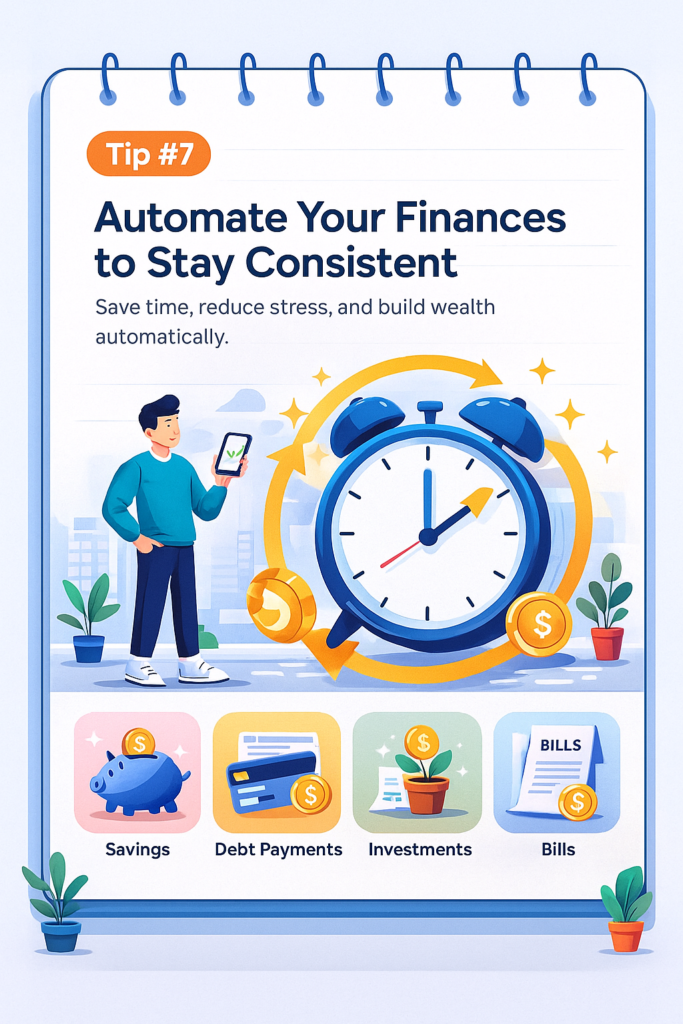
Automation is one of the most underrated yet powerful strategies in personal finance. Many people struggle with consistency — saving one month, forgetting the next; paying bills late; or losing track of debt payments. Automating your finances eliminates these problems by making your money work without requiring daily willpower.
Below is a deeply detailed breakdown designed for SEO optimization, readability, and maximum value.
—
What Does “Automating Your Finances” Really Mean?
Automating your finances means using digital tools, bank features, and budgeting apps to allow your money to automatically move to the right places without you manually doing it each month.
This includes automating:
✔ Savings transfers
✔ Emergency fund contributions
✔ Investment deposits
✔ Debt payments
✔ Bill payments
✔ Budget tracking
✔ Expense notifications
Instead of you managing money, the system manages it for you.
—
Why
Automation Is a Game-Changer (Backed by Psychology & Data)
One of the biggest obstacles for people is inconsistency. Even financially smart people fail to save or pay bills on time because life gets busy.
Automation solves these psychological problems:
Removes the need for daily discipline
When money moves automatically, you don’t need motivation or memory.
Prevents emotional spending
If your money goes to savings before you touch it, you can’t spend it carelessly.
Ensures consistent progress
Even when you’re busy, sick, traveling, or stressed, your financial system keeps working.
Reduces stress and decision fatigue
Fewer decisions = fewer mistakes.
Builds habits effortlessly
Repeating automated actions creates long-term stability.
—
How to Set Up Full Financial Automation (Step-by-Step Guide)
This section is designed for SEO and actionable advice.
—
Step 1: Choose a Primary Bank for Incoming Income
Make sure salary or business earnings land in one main account. This is the “root” of your financial tree.
SEO Keywords: primary account, salary account, personal finance setup, banking automation.
—
Step 2: Set Automatic Transfers for Savings
Automate a percentage of income (even 5–10%) to a dedicated savings account.
Set this transfer to happen:
the same day your income arrives
every month without fail
This protects your money before you start spending.
—
Step 3: Automate Your Emergency Fund Contributions
Your emergency fund should grow every month without manual effort.
Example:
Every 1st date → $10 / $20 / $50 to Emergency Account
Continue until you hit 3–6 months of expenses
This creates financial protection instantly.
—
Step 4: Automate Debt Payments
High-interest debt becomes cheaper and easier when paid automatically.
Automation helps you:
avoid late fees
reduce interest accumulation
build a perfect payment history
Set automatic payments for: ✔ Credit cards
✔ Loans
✔ Financing plans
—
Step 5: Automate Investments
If you invest manually, you’ll skip months.
Automated investing ensures long-term growth.
Examples:
Automatic weekly crypto buys
Automatic stock purchases
Monthly index fund deposits
Automated micro-investing apps
Even $5–$20 regularly compounds hugely over years.
—
Step 6: Set Up Auto-Bill Pay
Automate payments for: ✔ Internet
✔ Phone
✔ Subscriptions
✔ Rent (if your bank supports it)
✔ Insurance
✔ Utilities
This protects your credit and financial reputation.
—
Step 7: Use Budgeting Apps with Auto-Tracking
Apps like:
YNAB
PocketGuard
Mint
Spendee
GoodBudget
These sync your bank transactions automatically and categorize spending for you.
This gives you full visibility without manual work.
—
Benefits of Full Financial Automation
This section is written SEO-style with keyword inclusion.
1. You save more without trying
People who automate savings save 2x to 4x more than those who don’t.
2. You become debt-free faster
Automatic payments shorten debt payoff time.
3. You reduce financial stress
You always know bills are paid and savings are growing.
4. You avoid late fees
Automation protects your credit score.
5. You build long-term wealth effortlessly
Your money grows while you sleep.
—
Common Mistakes to Avoid When Automating Finances
To make the post deeper and more SEO-friendly.
Automating without checking balances
Not updating automation when income changes
Too many small automations that become confusing
Forgetting subscription renewals
Ignoring account alerts
—
Pro Tips to Make Financial Automation Even More Powerful
Use a “Two-Account System”
Account 1 → Salary
Account 2 → Spending
Everything else (savings, investments, bills) is automated before money reaches your hands.
Add Alerts
Set notifications for:
low balance
large purchases
deposit confirmation
failed automation
Review automation every 3 months
This ensures your system stays aligned with your goals.
—
Conclusion: Automation = Financial Freedom
Automating your finances is like hiring a personal financial assistant who works 24/7.
It keeps you consistent, protects your money, prevents stress, and helps you build wealth automatically.
Even if you start small, automation creates long-term transformation.
One of the most powerful habits you can build on your financial journey is tracking your spending consistently. Most people don’t realize where their money goes until they start monitoring it — and once they do, everything becomes clearer: the leaks, the unnecessary expenses, and the habits that slow down financial progress.
Tracking your spending is not about restricting your life.
It’s about understanding your money, recognizing patterns, and making smarter decisions. When you know exactly where every dollar is going, you gain the confidence and clarity to plan your future wisely.
Why Tracking Your Spending Matters
Here’s what happens the moment you start tracking:
You quickly identify where you waste money without realizing it.
You become more intentional with every purchase.
Your savings increase naturally.
You reduce overspending and impulse buying.
You gain full control over your financial life.
Simply put: You can’t fix what you don’t measure.
How to Track Your Spending Effectively
You don’t need complicated systems. These simple methods work extremely well:
1. Use a Budgeting App
Apps like PocketGuard, Mint, Goodbudget, or any local mobile banking tracker can automatically categorize your spending. You just check in weekly.
2. Use a Simple Google Sheet or Notebook
Some people prefer manual tracking. Writing things down increases awareness and discipline.
3. Review Your Daily or Weekly Spending
Set 5–10 minutes every week to check your expenses.
This habit alone can change your entire financial lifestyle.
4. Create Spending Categories
Break expenses into simple groups:
Essentials: Rent, food, bills, transport
Important: Savings, investments, emergency fund
Optional: Restaurants, entertainment, clothing
Waste: Things you regret buying
Once you see your “waste” clearly, it becomes easier to reduce it.
What You Gain from Tracking Spending
More savings without stress
Better budgeting
Financial peace of mind
Faster progress toward your goals
A realistic picture of your spending behavior
Tracking spending is a habit that pays you back every single day.
Building wealth is not about one big decision — it’s about small actions repeated consistently. One of the most effective ways to make sure you stay on track is to automate your savings. When your savings happen without you manually transferring money, you remove temptation, reduce stress, and guarantee progress toward your financial goals.
Automation ensures that every time you earn money, part of it moves directly into your savings or investment accounts. This makes saving effortless, consistent, and predictable — even during busy or stressful periods.
Why Automating Your Savings Works
You save before you spend, preventing overspending.
It builds a habit without requiring daily discipline.
You avoid forgetting to save during months when expenses feel heavy.
Your wealth grows steadily, even with small contributions.
It reduces financial stress by giving your money a clear plan.
How to Automate Your Savings Effectively
1. Choose Your Savings Goal
It could be an emergency fund, travel savings, a business fund, or long-term investing.
2. Decide the Percentage You Can Save Automatically
Even 5%–10% of your income makes a huge difference over time.
3. Set Up Automatic Transfers
Most banks allow you to schedule automatic weekly or monthly transfers.
4. Use Budgeting Apps or Digital Banks
Many apps automatically separate your money into “saving buckets” the moment you get paid.
5. Increase the Amount Over Time
Whenever your income grows, adjust your automated savings upward.
The Power of “Set It and Forget It”
Automating your savings removes emotional decisions. You don’t have to think about discipline, motivation, or timing — the system handles everything. Over several months, you’ll start to see visible progress, which boosts confidence and keeps you focused.
Long-Term Benefits
More financial stability
Less stress during emergencies
Faster progress toward major goals
Stronger credit and financial profile
A foundation for long-term investing
—
A Step-by-Step Guide to Protecting Your Financial Future
An emergency fund is one of the most important pillars of strong personal finance. No matter how stable your income seems, life can always throw unexpected challenges—medical emergencies, job loss, car repairs, family needs, or sudden bills.
Having an emergency fund ensures that you stay safe, confident, and financially protected during difficult times.
In this guide, you will learn what an emergency fund is, why you need it, and how to build it even if your income is small.
—
What Is an Emergency Fund?
An emergency fund is a separate amount of money saved to cover unexpected expenses. This money is not for shopping, travel, entertainment, or normal bills.
It is ONLY for real emergencies.
Examples of true emergencies:
Medical treatments
Job loss
Urgent home or car repairs
Unexpected family needs
Sudden income interruption
Having money ready for these moments protects you from taking loans, falling into debt, or selling your belongings.
—
Why You Need an Emergency Fund
Building an emergency fund gives you:
1. Financial Security
You won’t panic when an unexpected expense appears.
2. Peace of Mind
Knowing that you have savings reduces stress and improves decision-making.
3. Protection From Debt
When emergencies happen, many people borrow money at high interest. An emergency fund saves you from that trap.
4. Freedom to Make Better Choices
You can change jobs, start a side hustle, or move houses without fear of going broke.
—
How Much Should You Save?
Most financial experts recommend:
➤ Save 3–6 months of your monthly expenses
Example:
If you spend $200 per month, aim for $600–$1,200 in your emergency fund.
But don’t worry if that sounds too big. You can start small.
If your income is low, start with this simple rule:
✔ Save $1 a day
✔ Save $5–$10 per week
✔ Save 10% of any extra income
Small steps build a big result over time.
—
Where Should You Keep Your Emergency Fund?
Keep your emergency fund in a safe, separate place, such as:
A savings account
Mobile money savings feature (if available in your country)
A secure bank account
A digital wallet with savings options
Do NOT mix it with your daily spending money.
—
How to Start Building Your Emergency Fund
Follow these steps:
1. Calculate Your Monthly Needs
Include:
Food
Transport
Rent
Utilities
School fees
Medical expenses
This helps you know the exact target.
2. Cut Small Unnecessary Expenses
Even small things add up:
Eating out too often
Extra subscriptions
Unplanned shopping
Redirect that money to your emergency fund.
3. Automate Your Savings
If possible, set automatic transfers weekly or monthly.
This is the easiest way to stay consistent.
4. Increase Your Savings When Income Grows
Any extra income (freelancing, business, bonuses) → put part of it aside.
5. Never Use the Fund Unless It’s Truly an Emergency
This maintains discipline and keeps your fund growing.
—
How Long Does It Take to Build an Emergency Fund?
It depends on your income, discipline, and lifestyle.
Some people build their fund in 3 months, others in 1 year.
The goal is consistency—not speed.
Even saving $20 per month is better than saving nothing.
—
Common Mistakes to Avoid
Using the fund for normal expenses
Saving without a target
Keeping the money where you can easily spend it
Not reviewing your progress monthly
Avoiding these mistakes will help your emergency fund grow faster.
—
Final Thoughts
An emergency fund is not just money—it is security, confidence, and financial freedom.
Even if you earn a small income, starting with tiny contributions can transform your financial life over time.
—
—
Introduction
Life is unpredictable. Emergencies don’t ask permission. They don’t follow your schedule. They don’t wait for your salary date.
A sudden medical bill, a family crisis, a broken phone, a job loss, or even a simple repair can push a person into debt within hours.
This is why every financial expert agrees on one rule:
> The first step to financial stability is building an emergency fund.
Not investing.
Not budgeting.
Not saving for goals.
Your emergency fund is Step Number One.
In this comprehensive guide, we explore everything you need:
What an emergency fund really is
Why it matters
How much to save
How to start even with low income
Where to keep the money
How to grow the fund
How to protect it
Common mistakes people make
Step-by-step plan for your first 100 days
This article will be your ultimate guide — long, practical, and beginner-friendly.
—
1. What Exactly Is an Emergency Fund?
An emergency fund is a dedicated savings pool meant only for unexpected, urgent situations.
It is not for wants, vacations, new clothes, impulse shopping, or entertainment.
It is specifically meant for:
Medical emergencies
Job loss or income interruption
Family emergencies
Urgent repairs (home or phone)
Essential travel
Emergency bills
Unplanned financial shocks
Think of it as your personal financial shield.
—
2. Why an Emergency Fund Matters More Than Anything Else
Most people underestimate emergencies until they happen. But emergencies are not rare—they are guaranteed.
Here’s why an emergency fund is life-changing:
✔ 1. It protects you from debt
Without savings, the first place you run to is:
Loans
Credit
Borrowing from friends
High-interest lenders
One emergency can trap you in debt for years.
✔ 2. It reduces stress and fear
Money problems destroy peace of mind. But when you have an emergency fund, you feel calm — even when life becomes chaotic.
✔ 3. It gives you financial confidence
You make smarter decisions when you’re not worried constantly.
✔ 4. It prevents paycheck-to-paycheck living
Many people survive by hoping “nothing goes wrong.”
Emergency funds break that cycle.
✔ 5. It helps you focus on long-term goals
When emergencies are covered, you can focus on:
Saving
Investing
Starting a business
Improving your life
—
3. How Much Should You Save? (Beginner, Intermediate, Expert Levels)
Level 1: Starter Emergency Fund (Beginners)
Save $50 – $200 first.
This is your seed.
Small, but powerful.
Level 2: Basic Emergency Fund (Stable Stage)
Save 1 month of living expenses.
This covers rent, food, transport, essentials.
Level 3: Strong Emergency Fund (Experts)
Save 3–6 months of living expenses.
Most financial experts recommend this amount.
Level 4: Maximum Security Fund
Save 12 months of living expenses if:
You have unstable income
You’re self-employed
You live in an expensive city
You support many people
—
4. How to Calculate Your Emergency Fund
Write down your real monthly expenses:
Category Amount
Rent / Housing X
Food X
Transport X
Utilities X
Medical X
Communication (data/airtime) X
Family support X
Other essentials X
Add all of them.
Multiply by 3 or 6.
This is your goal.
—
5. Where Should You Keep Your Emergency Fund?
The money must be:
Accessible
Safe
Separated from your main money
Not easy to withdraw impulsively
Best places to keep it:
1. Dedicated savings account
2. Mobile savings wallet (with lock feature)
3. Bank digital savings plan
4. High-yield savings accounts (if available in your country)
❌ Never keep your emergency fund in:
Cash at home (unsafe)
Investment accounts (prices can drop)
Business capital
Crypto (too volatile)
Normal spending account (too tempting)
—
6. How to Build an Emergency Fund Even With Low Income
People with small incomes assume they can’t save.
That’s wrong.
Here’s how to start even with very little money:
✔ 1. Start extremely small
Save $1, $2, or $5
Small savings accumulate faster than you think.
✔ 2. Use automation
Set your bank to auto-transfer weekly.
✔ 3. Save unexpected money
Bonuses
Gifts
Side job income
Business profits
Refunds
✔ 4. Cut one unnecessary expense
One meal
One soda
One coffee
One subscription
Redirect it to your fund.
✔ 5. Sell unused items
Old clothes
Old phones
Accessories
Books
Shoes
Small items
Turn them into savings.
—
7. The Psychology of Saving
Money habits come from:
Discipline
Awareness
Emotional control
Saving is 80% mindset, 20% income.
When you commit mentally, your bank account follows.
—
8. Signs You Need an Emergency Fund Immediately
You panic when you have bills
You borrow often
You have no backup income
You support your family
You live paycheck to paycheck
One emergency would destroy your finances
If any of these apply,
your emergency fund is a priority starting today.
—
9. Common Mistakes People Make
❌ Using the fund for non-emergencies
❌ Keeping money where it’s too easy to withdraw
❌ Not replacing money after using it
❌ Believing income is too small to save
❌ Waiting for “the right time”
❌ Mixing emergency funds with investments
—
10. How to Rebuild Your Emergency Fund After Using It
If you use the fund, that’s okay.
That’s why it exists.
Here’s how to rebuild it:
✔ Step 1: Replace money gradually
✔ Step 2: Pause unnecessary expenses
✔ Step 3: Add extra money from side jobs
✔ Step 4: Track your progress weekly
—
11. 100-Day Emergency Fund Challenge
This plan makes saving simple.
Day 1–30
Save small ($1–$3 per day)
Day 31–60
Save medium ($3–$5 per day)
Day 61–100
Save bigger ($5–$7 per day)
By Day 100, you’ll have a solid foundation.
—
12. Long-Term Benefits of an Emergency Fund
You sleep better
You feel more confident
You stop borrowing
You build wealth faster
You invest without fear
You avoid financial crises
—
13. Frequently Asked Questions (FAQ)
Q1: What if I have debt? Should I save first?
Yes. Start with a small emergency fund before paying debts aggressively.
Q2: How do I avoid touching the money?
Keep it in a separate, locked account.
Q3: Should I tell family about it?
No, unless you trust them not to misuse your generosity.
—
Conclusion
Your emergency fund is your financial foundation.
Without it, every step becomes risky.
With it, you gain stability, confidence, and long-term security.
Start today, even if the amount is small.
Your future self will thank you.
—
Introduction
Before you can improve your financial life, you must first understand your current financial situation. Most people struggle with money not because they lack income, but because they don’t clearly know where their money goes, how much they owe, or what their true financial position is.
Knowing where you stand financially is the first and most important step toward financial stability and long-term wealth.
In this guide, we break down exactly how to assess your finances and build a clear picture of your money.
—
What Does “Knowing Your Financial Position” Mean?
It means having a complete and accurate understanding of:
How much money you earn
How much you spend
How much you owe (debts)
How much you save
Your financial habits
What risks you face
What goals you want to achieve
Once you know these, you can control your finances instead of letting money control you.
—
1. Calculate Your Total Monthly Income
Start by listing every source of income you have:
Full-time or part-time job
Freelancing or online work
Small businesses
Side hustles
Commissions or bonuses
Money from services (transport, repairs, etc.)
Add all of them to get your total monthly income.
This number is the foundation for every decision you make.
—
2. Track All Your Monthly Expenses
You cannot improve what you do not measure.
List all your spending for the last 30 days.
Split your expenses into two groups:
A. Essential (Needs)
Food
Rent or housing
Transport
Utilities (electricity, water, internet)
School fees
Medical needs
B. Non-essential (Wants)
Eating out
Entertainment
Shopping
Subscriptions
Luxury items
When you separate these categories, you immediately see where your money leaks.
—
3. List All Your Debts and Responsibilities
Many people avoid checking their debts because it feels uncomfortable.
But ignoring debt only makes it worse.
Write down:
Loans
Credit owed to people
Business debts
Unpaid bills
Installments
Then calculate your total debt.
This helps you plan repayments realistically.
—
4. Review Your Savings and Assets
Knowing what you own is as important as knowing what you owe.
Your assets may include:
Savings account
Mobile money balance
Cash reserves
Land or property
Investments
Equipment or tools used for income
Digital assets
This gives you a clear picture of your net worth.
—
5. Compare Your Income vs. Expenses
This step shows your real financial health:
✔ If income > expenses → you are financially positive
You have room to save, invest, and grow.
✔ If expenses > income → you are financially stressed
You may need to reduce spending or increase income.
✔ If they are equal → no growth, no savings
This is called “living paycheck to paycheck.”
—
6. Identify Financial Weaknesses and Risks
These may include:
No emergency fund
Too many small expenses
Uncontrolled debt
Irregular income
No savings plan
Overspending on non-essential items
Knowing your weaknesses helps you fix them fast.
—
7. Set Clear Financial Goals
Once you know your starting point, choose where you want to go:
Build an emergency fund
Pay off debt
Save for a business
Invest for the future
Increase income
Improve credit reputation
Clear goals guide every financial decision you make.
—
Why This Step Is So Important
Knowing where you stand financially:
Helps you stay disciplined
Prevents financial surprises
Makes budgeting easier
Improves decision-making
Builds confidence and control
Shows you exactly what needs improvement
This is the foundation of smart personal finance.
—
—
Introduction
Budgeting helps you take full control of your finances and understand exactly where your money goes each month. It is one of the most important steps for anyone who wants to build a strong and stable financial future.
While many people think budgeting is complicated, it is actually a simple system that can save you a lot of money and prevent financial stress.
—
1. Calculate Your Total Monthly Income
Start by knowing your exact monthly income.
This includes:
Salary
Freelance payments
Business income
Commissions
Side hustle earnings
Your budget can only work if your income is accurate.
—
2. Track All Your Monthly Expenses
Write down every expense you have each month.
Essential Expenses (Needs):
Rent / Housing
Food and groceries
Transportation
Water & electricity
Internet & phone bills
Non-Essential Expenses (Wants):
Entertainment
Unnecessary clothing
Eating out
Shopping
Travel
Tip:
Use apps like Monefy, Notion, or Google Sheets to track spending easily.
—
3. Use the 50/30/20 Budgeting Rule
This is one of the most popular budgeting methods:
50% → Needs (essential living expenses)
30% → Wants (non-essential but enjoyable)
20% → Savings + investments
If your income is low, adjust it to:
60/25/15
70/20/10
The goal is to create a system that fits your real situation.
—
4. Identify and Reduce Wasteful Spending
After listing your expenses, you will notice unnecessary spending that eats your money.
Examples:
Eating out too often
Subscriptions you never use
Expensive transportation
Buying things you don’t need
Cutting these small costs can save a lot of money every month.
—
5. Set Clear Financial Goals
Your budget should support your goals, such as:
Building an emergency fund
Paying off debt
Saving for a house
Investing for the future
Growing your side income
Write down each goal clearly so you stay focused.
—
6. Use Separate Accounts
To manage your money more effectively, divide your accounts:
One account for expenses
Another for savings
Another for investments
This prevents mixing money and reduces impulse spending.
—
7. Review and Adjust Your Budget Every Month
A budget is not something you create once and forget.
Every month:
Check how much you earned
Compare expected vs actual expenses
Adjust overspending areas
Increase savings if you can
Update any financial changes
A flexible budget is a successful budget.
—
Conclusion
A good budget is simple, realistic, and easy to follow.
It helps you reduce unnecessary spending, increase savings, and build a long-term financial foundation that protects you from stress and uncertainty.
Budgeting is a habit — not a one-time activity.
—
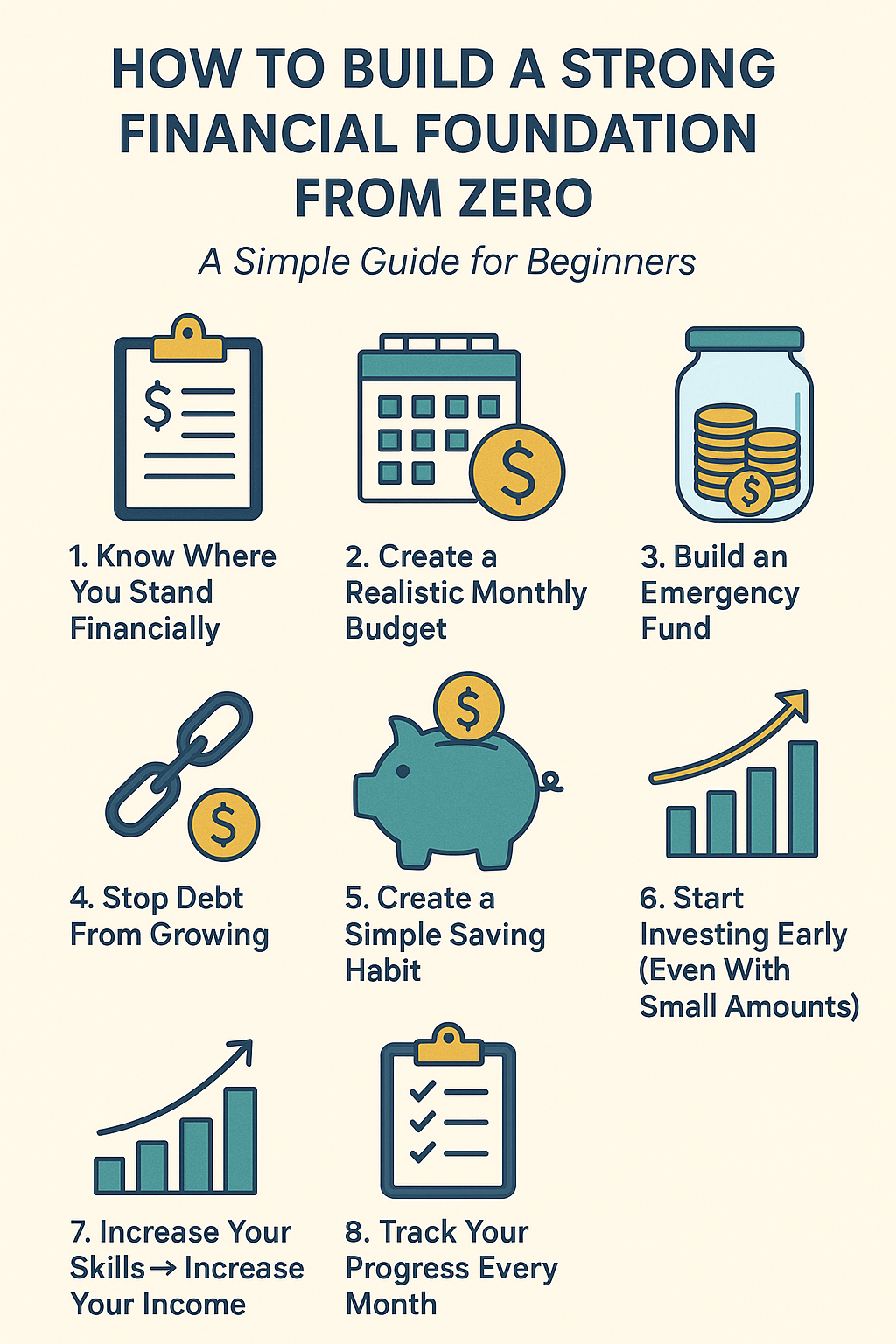
(A Simple Guide for Beginners)
Introduction
Building a strong financial foundation doesn’t require being rich — it starts with simple habits, discipline, and understanding how money works. Whether you’re starting from zero or even from debt, the steps below will help you create a stable financial future.
—
1. Know Where You Stand Financially
Before you improve your money situation, you must understand it.
Ask yourself:
How much do I earn monthly?
How much do I spend?
Do I owe anyone?
Do I save anything?
Just writing these down gives you control.
—
2. Create a Realistic Monthly Budget
A budget is your financial map.
The easiest method for beginners is the 50/30/20 rule:
50% → needs (food, rent, transport)
30% → wants (entertainment, clothes)
20% → savings + investments
If income is small, you can adjust it to 60/25/15 or even 70/20/10.
—
3. Build an Emergency Fund
Life is unpredictable — losing a job, falling sick, or facing sudden expenses.
Start saving little by little until you reach:
1–3 months of expenses (beginners)
3–6 months (ideal)
Even saving $1–5 a day builds a strong cushion over time.
—
4. Stop Debt From Growing
Debt kills your financial progress.
Follow this order:
Stop borrowing completely
Pay high-interest loans first
Avoid “quick money” borrowing apps
Negotiate if possible
You can’t build wealth while debt is growing.
—
5. Create a Simple Saving Habit
Wealth starts with consistent saving, not big numbers.
Try this:
Save 10% of all income automatically
Use a separate account
Never touch savings except for emergencies
This creates discipline and long-term growth.
—
6. Start Investing Early (Even With Small Amounts)
You don’t need big money to invest.
Begin with:
Mobile investment apps
Simple index funds
Gold savings
Low-risk plans (depending on your country)
Small investments grow massively because of compound interest.
—
7. Increase Your Skills → Increase Your Income
The fastest way to grow financially is to grow your skills.
Learn high-income skills
Improve your profession
Take online courses
Start freelancing or side hustles
More income = more saving + more investing.
—
8. Track Your Progress Every Month
Review:
What you earned
What you saved
What you invested
What you overspent
This keeps you accountable and motivated.
—
Conclusion
A strong financial foundation is not about being rich — it’s about having control, planning ahead, and making smart decisions. Start small, stay consistent, and your money will grow with time.
—