

Managing and growing money has become easier than ever before. You no longer need to walk into a bank, find an investor, or understand complicated charts before investing. Today, everything happens from your phone—within minutes.
However, with thousands of platforms online, the challenge now is not how to invest but where to invest safely and get long-term benefits.
In this guide, we will go step-by-step through how a beginner can choose the right investment platform in 2025. Whether your goal is to buy stocks, save for the future, invest small amounts, or build long-term wealth, this article simplifies it all.
—
—
Why Choosing the Right Platform Matters
Before putting your money anywhere, you must understand the impact of choosing the right platform:
✔ Your money’s safety depends on the platform
Not every website is regulated, and some disappear with user funds.
✔ Your profits depend on fees
A platform may charge hidden withdrawal fees, high commissions, or conversion fees.
✔ Your ability to grow depends on available tools
Some platforms help you:
track stocks,
automate investments,
educate you,
and offer fractional shares.
So choosing correctly can either build wealth or cause losses.
—
—
What Makes an Investment Platform Good in 2025?
When selecting an investment app or brokerage, look for:
—
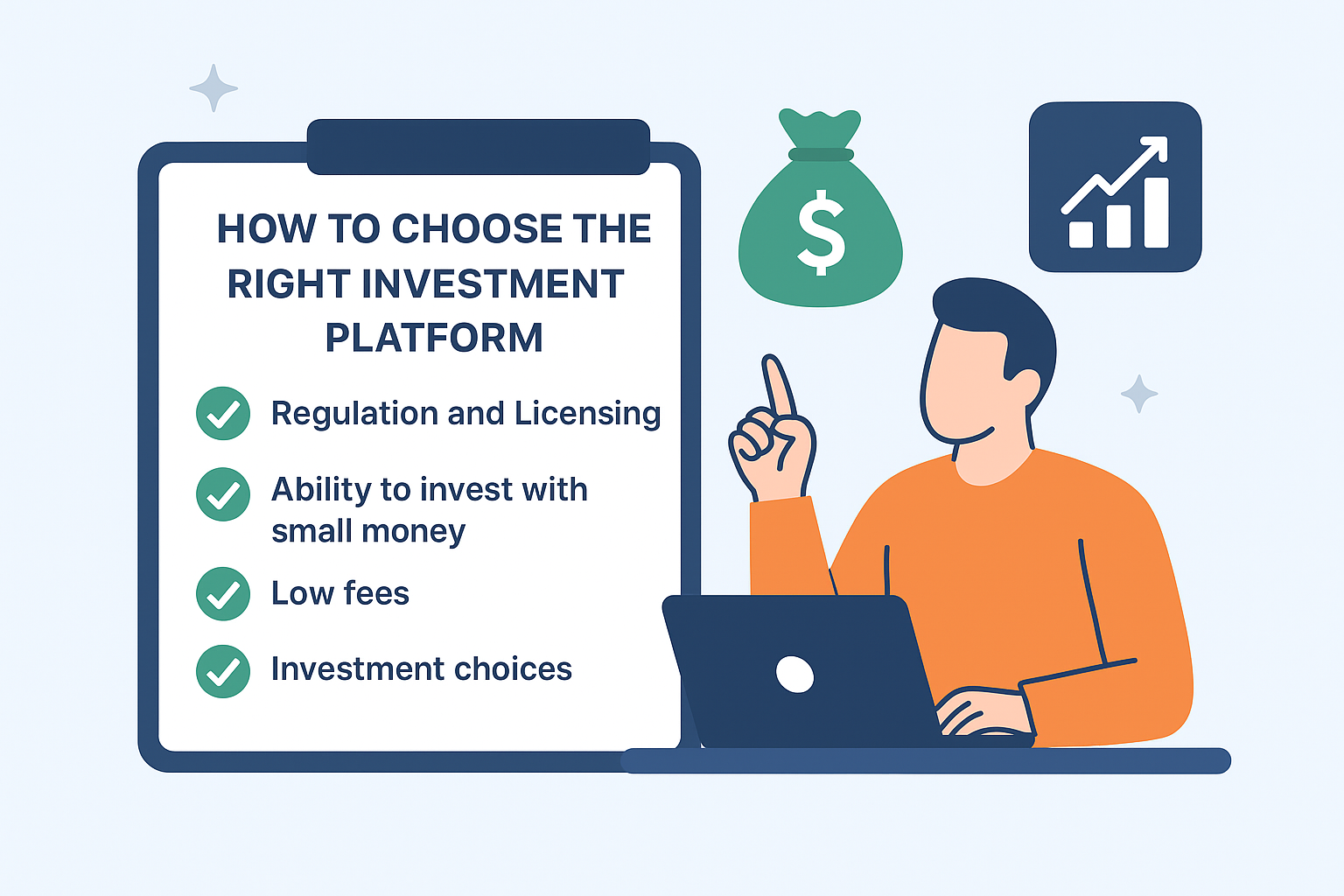
1. Regulation & Licensing (Most Important Factor)
This determines whether your money is legally protected.
Look for platforms regulated by:
FCA (UK)
CySEC (Europe)
SEC (USA)
ASIC (Australia)
Why this matters:
If something happens to the platform, regulators ensure you receive compensation and proper reporting.
—
2. Ability to Invest With Small Money
Beginners rarely start large.
A good platform should allow: ✔ $5–$50 deposits
✔ fractional shares
✔ no penalty for low accounts
Example: Buying Apple stock for $10 (fractional, not full share).
—
3. Low Fees
Watch out for:
deposit charges
withdrawal fees
trading commissions
inactivity fees
Some platforms earn more through fees than through real trading.
—
4. Investment Choices
A strong platform should allow access to: ✔ stocks
✔ ETFs
✔ bonds
✔ cryptocurrencies (optional)
✔ global markets
This helps diversify your risk.
Example:
Apple stock drops → bond investment still earns stable returns.
—
5. Research Tools Included
Good platforms give:
real-time charts
company financial reports
analysis tools
educational sections
This helps beginners make informed decisions—not emotional ones.
—
—
Signs of a Weak or Risky Investment Platform
Avoid platforms that:
❌ Have no regulatory license
❌ Have complicated withdrawal processes
❌ Promise guaranteed profit
❌ Ask for deposits before account verification
❌ Have little or no customer support
❌ Push signals and VIP paid trading groups
If a platform promises:
> “Guaranteed 50% in one week”
That is a scam.
Investment returns always fluctuate.
—
—
Top Investment Categories for Beginners
Before choosing the platform, choose your direction.
—
Category 1: Long-Term Stock Investing
Best for: ✔ Job holders
✔ Students
✔ People building financial freedom
Why?
Stocks historically outperform banks.
Average 10-year return: 7%–12% annually.
Best for: ⏳ Long term (2–10+ years)
—
Category 2: ETFs
ETF stands for “Exchange-Traded Fund”:
instead of buying one company, you buy 100–500 companies at once.
Example: S&P 500 ETF = Investment into top 500 US companies
This protects your money from single company risk.
—
Category 3: Bonds
Low risk
Stable
Government-backed
Return range: 3%–6% yearly
Perfect for emergency savings.
—
Category 4: Real-Time Trading (Active Trading)
Most beginners want trading because: “money moves fast”.
But note:
> 80% of beginners lose money in trading
Trading is skill-based, emotional, and risky.
Only recommended after learning.
—
—
Step-by-Step Guide: How to Choose an Investment Platform Today
—
Step 1: Confirm Regulation
Visit their website footer
Check license details
Search license on regulator website
If you cannot find it—skip that platform.
—
Step 2: Check Deposit and Withdrawal Options
Look for: ✔ Mobile wallet support
✔ Visa/Mastercard
✔ Bank transfer
✔ Local processing
Withdrawal times should not exceed 48–72 hours.
—
Step 3: Check Fees
Good fees look like:
0% deposit fee
0% withdrawal fee
Low trading commission
If fee structure is hidden → avoid them.
—
Step 4: Check Market Access
A good platform allows investments into: ✔ US markets
✔ European markets
✔ Global ETFs
Why?
More choice = less risk + higher opportunity.
—
Step 5: See If They Support Fractional Investing
Example:
Instead of buying Tesla at $200
You purchase: 👉 $5 worth
This is beginner-friendly.
—
—
How Beginners Can Start With Only $10–$100
Even small money can grow long term:
Example:
Investing $20 every month
10% average yearly return
10 years later = Approx $4,200–$6,000
If you increase contribution → results double.
This is called Dollar-Cost Averaging (DCA).
—
—
Common Mistakes Beginners Make
Avoid these:
—
❌ Investing without research
People follow trends: “Dollar is falling, invest here” “Gold is rising, buy now” “Crypto is exploding”
These emotional choices cause losses.
—
❌ Investing large amount immediately
Start small
Increase gradually
—
❌ Trading before understanding charts
Trading is not luck
It’s strategy.
—
❌ Not diversifying
Example mistake: “Buy only crypto” “Buy only one company”
Diversify = reduce damage.
—
—
How to Build a Simple Beginner Portfolio
Example Starter Portfolio ($100)
Asset Type Amount Reason
ETF (S&P500) $50 Broad exposure
Stock (Apple/Google/Meta) $30 Long-term growth
Bond/Fixed Savings $20 Safety / balance
This structure protects you from heavy loss.
—
What You Should Research Before Buying
Look at: ✔ Company revenue
✔ Future plans
✔ Stability
✔ Market demand
Example:
Apple’s income comes from devices + services
High innovation
Brand loyalty
Low risk
→ Suitable for long term
—
—
The Golden Rule of Smart Investing
> Buy companies and assets you truly understand.
If you don’t understand crypto → avoid it
If a company is unclear → avoid it
If investment feels suspicious → avoid it
Money is safer when decisions are simple.
—
—
Final Conclusion
If you are just starting your investment journey in 2025, take it step-by-step:
✔ Choose regulated platforms
✔ Start with small amounts
✔ Avoid hype and shortcuts
✔ Diversify your portfolio
✔ Think long-term
You don’t need thousands to start.
You only need consistency, patience, and knowledge.
In 5–10 years, these small investments can turn into a strong financial foundation—especially if you follow the rules mentioned in this guide.
- Smart Personal Finance Guide for Everyday PeoplePractical Money Skills for Budgeting, Saving, Investing & Financial FreedomBy Dhilaalo.com
- Personal Finance Mastery: Smart Money Management, Investing Strategies & Financial Freedom Guide
- How to Build Wealth Smarter in 2026
A Practical, Modern Guide to Financial Growth and Long-Term Stability - Mastering Personal Finance: A Complete Guide to Building Wealth and Financial Freedom
- How to Invest for the Long Term: A Simple Strategy for Beginners