Saving money today feels incredibly difficult, especially for young adults just starting their careers. High inflation and the rising cost of living across the United States have forced many into a stressful cycle of living paycheck to paycheck.
Yet, at 23 years old and living in Minnesota, I successfully saved $40,000 in pure cash in just twelve months.
I did not inherit a fortune, nor do I work a high-paying tech job. I am a young construction worker who simply relied on strict financial discipline, realistic math, and a strategic lifestyle change.
Here is the exact blueprint I used to reach my savings milestone, and how you can do it too.

To save aggressively, you must look at your actual net take-home pay rather than your gross earnings.
My hourly wage is $38.50. Working 8 hours a day, 6 days a week equates to roughly 48 hours per week. This brings my annual gross income to $96,096 ($8,008 per month before taxes).
However, a major trap young professionals fall into is budgeting based on their gross pay.
Living in Minnesota, mandatory annual deductions—including Federal Income Tax, Minnesota State Tax, and FICA (Social Security and Medicare)—total roughly $22,851. This leaves me with a real take-home net income of $73,245 per year (approximately $6,104 per month).
To secure a $40,000 annual savings cushion, I had to cut my expenses down to a strict minimalist framework. While the average single adult in the Minneapolis-St. Paul metro area spends around $3,000 per month, I limited my monthly living expenses to exactly $2,000 ($24,000 annually).
I achieved this target through three major cost-cutting habits:
No Signup • No Login • No Watermark
Remove BackgroundPeople often ask me, “How do you find the time to manage your money, cook, or even rest with that schedule?”
My daily time management breakdown is very strict:
This schedule leaves me with exactly 7 hours of free time daily. Instead of spending those remaining hours scrolling aimlessly through social media, I dedicate that time to studying personal finance and building digital web tools to generate passive income for the future.
100% Free • No Signup • Fast & Secure
Open PDF ToolsBy consistently saving $49,245 annually (living on $2,000 a month), I will accumulate $246,225 in total cash after 5 years.
My financial goal is clear: I refuse to take bank loans or mortgages.
If you are a young worker in your early 20s, do not let the current economy discourage you. You do not need a massive six-figure starting salary to build wealth. Success requires clear math, patience, and the discipline to control your lifestyle for a few years so you can live the rest of your life completely debt-free.
What is the biggest expense holding back your savings goals right now? Let me know in the comments section below!
Take control of your financial future with our comprehensive personal finance solution. Designed to empower you with the tools and knowledge you need to make informed decisions, this product offers a user-friendly interface, personalized budgeting features, and expert guidance to help you achieve your financial goals. From tracking expenses and managing debt to planning for retirement and building wealth, our personal finance solution is your trusted partner on the path to financial well-being.
The good news is that you don’t need to be rich to start building wealth. With the right personal finance tips, you can save money, reduce stress, and grow your income over time.
In this guide, you will learn simple, practical, and beginner-friendly strategies to help you take control of your finances and build a better future.
Personal finance is how you manage your money. It includes:
When you understand these basics, you gain full control over your financial life.
Saving money gives you freedom and security. Without savings, even small problems can become big financial issues.
A budget is the foundation of good financial management.
Use the 50/30/20 rule:
This method is simple and effective for beginners.
Most people lose money because they don’t track it.
Tracking helps you understand where your money goes.
Life is unpredictable. You must be prepared.
Save at least:
This fund protects you from:
Debt is one of the biggest obstacles to financial success.
Good money management means controlling your debt.
Most people spend first and save later. This is a mistake.
This habit builds long-term wealth.
Saving is good, but investing is how you grow your money.
The earlier you start, the more you benefit from compound growth.
You cannot build wealth by saving alone.
More income means more opportunities to grow.
Goals give your money direction.
Break your goals into small steps to stay motivated.
Education is the key to success.
The more you learn, the better decisions you make.
Consistency is more important than perfection.
Small daily actions lead to big financial results over time.
These habits will help you achieve financial success.
Avoiding these mistakes can save you years of struggle.
Start by creating a budget and saving at least 20% of your income.
Aim for 3–6 months of expenses in an emergency fund.
Yes, but with proper knowledge, it can help grow your money.
Yes, by saving consistently and increasing your income.
Budgeting helps you control spending and reach financial goals.
Personal finance is not about how much money you make—it’s about how you manage it. By following these simple tips, you can take control of your finances, reduce stress, and build long-term wealth.
Start today. Even small steps can create big changes in your financial future.
💡 Remember: The journey to financial freedom begins with one smart decision.
Finding the best personal loan in today’s market can save you thousands of dollars. With the average APR hovering around 12.26% , but rates ranging from as low as 5.99% to 35.99% depending on your credit profile , shopping smart matters more than ever.

Whether you’re consolidating credit card debt, funding a home renovation, or covering an unexpected expense, this guide breaks down the best personal loan lenders for 2026 based on your specific needs and credit situation.
| Lender | APR Range | Loan Amounts | Terms | Best For |
|---|---|---|---|---|
| LightStream | 6.24% – 25.39% | $5,000 – $100,000 | 2-20 years | Excellent credit & long terms |
| SoFi | 8.74% – 35.49% | $5,000 – $100,000 | 2-7 years | Overall value & perks |
| Upstart | 6.5% – 35.99% | $1,000 – $75,000 | 3-5 years | Low/minimal credit |
| Discover | 7.99% – 24.99% | $2,500 – $40,000 | 3-7 years | Fair credit & no fees |
| PenFed Credit Union | 6.74% – 17.99% | $600 – $50,000 | 1-5 years | Small loans & low rates |
| Wells Fargo | 6.74% – 25.99% | $3,000 – $100,000 | 1-7 years | Existing customers |
| Upgrade | 7.74% – 35.99% | $1,000 – $50,000 | 2-7 years | Fair credit borrowers |
| Lending Club | 6.53% – 35.99% | $1,000 – $60,000 | 2-7 years | Debt consolidation |
*Rates accurate as of March 2026 *
Our recommendations are based on analysis of 30+ personal loan lenders using 15+ data points including :
Why we like it: SoFi combines competitive rates, borrower-friendly features, and valuable perks that extend beyond the loan itself .
Standout features:
Best for: Borrowers with good-to-excellent credit who want a lender that grows with them .
Why we like it: LightStream offers the lowest rates in the industry and the most flexible repayment terms—up to 20 years for qualified borrowers .
Standout features:
Important note: LightStream does not offer pre-qualification. You’ll need to submit a full application with a hard credit check .
Best for: Borrowers with excellent credit (700+ FICO) who want the lowest possible rate and longest repayment terms .
Credible lets you compare quotes from multiple lenders in minutes with a soft credit pull. Their $200 Best Rate Guarantee gives you a gift card if you find a lower rate elsewhere within 8 days .
Access to 300+ lenders including Best Egg, LendingClub, PenFed, and Discover. Their payment calculator helps estimate monthly costs .
Best for: Borrowers who want to shop multiple offers without multiple hard credit pulls.
Lending Club’s standout feature is their direct creditor payment service—they’ll pay off your credit cards or other loans directly, simplifying the consolidation process. They offer a 15-day late payment grace period and have excellent customer reviews (4.7 on Trustpilot) .
Best for: Borrowers consolidating credit card debt who want hands-on service.
Why we like it: Upstart uses AI to look beyond traditional credit scores, evaluating education, job history, and other factors .
Upstart accepts applicants with no credit history and considers alternative data. Most borrowers receive funds within one day .
Best for: Borrowers with thin credit files or scores in the 600-660 range.
Upgrade offers pre-qualification with a soft credit pull, direct creditor payment for debt consolidation, and a highly-rated mobile app (4.6 on Trustpilot with 53,000+ reviews) .
Best for: Fair credit borrowers (600-660) needing smaller loans.
Best for: Existing Wells Fargo customers seeking relationship discounts (0.25% for automatic payments from Wells Fargo account) .
Discover offers no hidden fees, next-day funding, and pre-qualification with no credit impact .
Best for: Borrowers with fair-to-good credit who want a trusted national bank.
Citigold and Citi Priority customers receive an additional 0.25% APR discount .
Best for: Existing Citi customers seeking competitive rates.
PenFed offers some of the lowest maximum rates in the industry (17.99%) and loans as small as $600—perfect for borrowers who don’t need thousands . Membership is easy: open a savings account with a $5 deposit .
Best for: Borrowers wanting small loans ($600-$5,000) with competitive rates.
First Tech accepts borrowers with bad credit and allows joint applications to improve approval odds. Membership is available through partner companies, the Computer History Museum, or the Financial Fitness Association .
Best for: Bad-credit borrowers willing to join a credit union.
BHG offers the highest maximum loan amount ($250,000) of any major lender. They specialize in loans for professionals with strong income but less-than-perfect credit .
Best for: Borrowers needing $50,000+ with good income.
| Lender | Funding Time | Requirements |
|---|---|---|
| LightStream | Same-day | Apply by 2:30 PM ET, complete approval |
| SoFi | Same-day | Apply by 5:30 PM ET, complete approval |
| Discover | Next business day | Standard approval |
| Wells Fargo | Next business day | Existing customers |
| Upstart | 1 day | Standard approval |
| Lender Type | Average APR |
|---|---|
| Credit Unions | 10.72% |
| Commercial Banks | 12.06% |
| Online Lenders | 6.49% – 35.99% |
Based on the average loan balance of $11,704 over 5 years :
| APR | Monthly Payment | Total Interest | Total Cost |
|---|---|---|---|
| 7% | $232 | $2,201 | $13,905 |
| 10% | $249 | $3,217 | $14,921 |
| 12% | $260 | $4,001 | $15,705 |
| 15% | $278 | $5,002 | $16,706 |
| 20% | $310 | $6,901 | $18,605 |
The bottom line: Improving your rate from 20% to 10% saves you $3,684—more than 30% of your original loan amount .
Your credit score determines which lenders you qualify for and what rates you’ll receive :
Use marketplaces like Credible or LendingTree to compare multiple offers with a single soft credit pull . Key factors to compare:
Most lenders except LightStream offer pre-qualification with a soft credit pull—this shows you potential rates without impacting your credit score .
Lenders want to see sufficient income to cover payments. Include all sources: job, side hustles, benefits, pensions .
Some lenders (SoFi, LightStream, Lending Club, First Tech) allow joint applications, which can improve approval odds and rates if your co-applicant has stronger credit .
A healthy savings account signals to lenders that you can make payments even if you hit a rough patch .
Legitimate lenders always evaluate your ability to repay. Guaranteed approval offers are often scams.
Never pay application or processing fees before you’ve received your loan.
Some lenders may try to upsell you. Borrow only what you truly need.
If a lender won’t clearly explain their APR, fees, or terms, walk away.
According to Bankrate’s forecast :
The bottom line: Rates will remain elevated but stable. Shopping around matters more than timing the market.
Generally, a 580 FICO score is the minimum for most lenders, but the best rates require 700+ . Some lenders like Upstart accept applicants with no credit history .
Same-day funding is available from LightStream (apply by 2:30 PM ET), SoFi (5:30 PM ET), and some banks. Most online lenders fund within 1-3 business days .
Some do, some don’t. LightStream, Discover, PenFed, and Wells Fargo charge no origination fees. Others like Upgrade (1.85% – 9.99%) and Lending Club (up to 8%) do charge them .
Most lenders do not charge prepayment penalties, including all lenders on our list . Paying early saves you interest.
Fixed rates stay the same for your entire loan term—most personal loans are fixed. Variable rates can change, but are very rare for personal loans .
Usually yes. The average credit card APR is over 20% , while personal loan rates average 12.26% and can go as low as 6% for well-qualified borrowers. A personal loan can save you thousands in interest .
| Your Situation | Recommended Lender |
|---|---|
| Excellent credit, want lowest rate | LightStream |
| Good credit, want overall value | SoFi |
| Fair credit (600-660) | Upgrade, Upstart |
| Low/minimal credit | Upstart |
| Small loan ($600-$2,000) | PenFed |
| Large loan ($50,000+) | BHG Money, LightStream |
| Debt consolidation | Lending Club |
| Existing bank customer | Wells Fargo, Citi, U.S. Bank |
| Compare multiple offers | Credible, LendingTree |
The most important takeaway: The “best” personal loan depends on your unique situation—your credit score, how much you need, and how quickly you can repay. Take time to compare offers, read the fine print, and choose a loan that fits your budget both today and for the full repayment term.
*Data sources: MoneyLion , Money.com , Bankrate , Moneywise , WalletHub . All rates and terms accurate as of March 2026. *
Artificial Intelligence is fundamentally reshaping how Americans borrow money. From instant approvals to AI-powered underwriting, the personal loan industry is undergoing its biggest transformation since the introduction of credit scores. This comprehensive report examines how AI is changing personal loans for millions of Americans in 2026, with real data, regulatory updates, and what it means for your wallet.
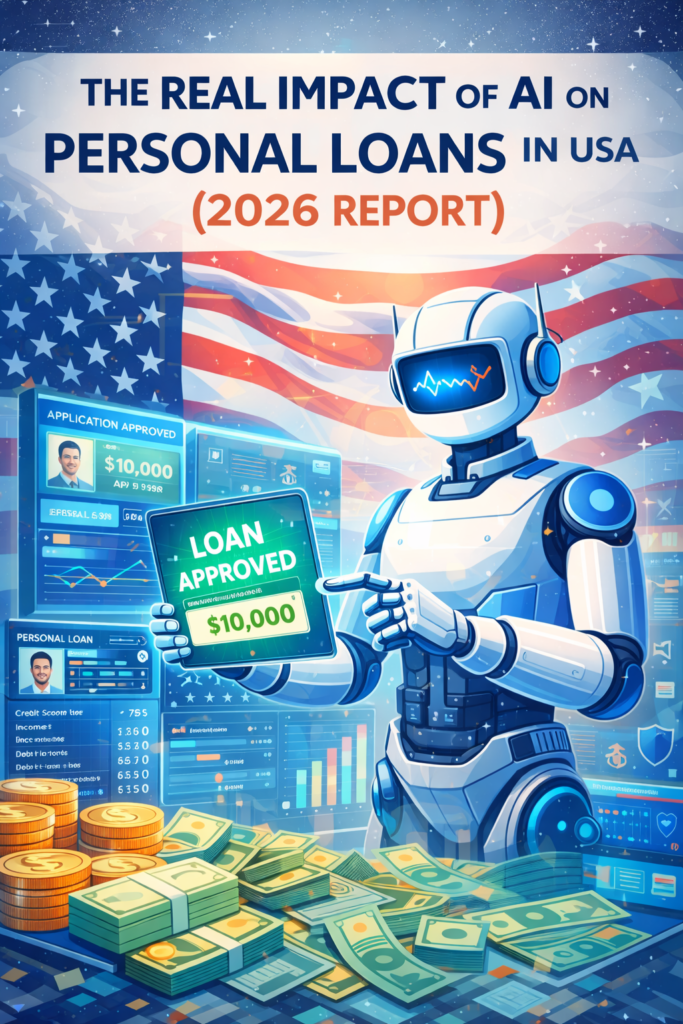
AI-powered personal loans use artificial intelligence and machine learning algorithms to evaluate borrowers, approve loans, and manage risk—replacing traditional manual processes and outdated credit scoring models.
Today’s AI lending systems analyze far more than just credit scores. According to industry experts, modern AI platforms evaluate:
This comprehensive analysis allows lenders to make faster, more accurate, and often fairer lending decisions than traditional methods.
The scale of automation is staggering: At leading AI lending platform Upstart, more than 90% of loans are fully automated with no human intervention required . This represents a complete reimagining of how personal loans are originated and managed.
In February 2026, Upstart (NASDAQ: UPST) announced Cash Line, a breakthrough revolving line of credit that represents the next evolution in AI-powered lending .
What makes Cash Line different:
| Feature | What It Means for Borrowers |
|---|---|
| Guaranteed minimum | $200 for all approved consumers—highest in the industry |
| Credit line | Up to $5,000 revolving (5X larger than competitors) |
| Always-on access | Lines never reduced if program requirements met |
| Instant funding | No extra fees for expedited access |
| Rest Mode | Customized repayment options unique to this product |
Pricing structure:
Dave Girouard, co-founder and CEO of Upstart, described Cash Line as “Upstart’s next great leap toward always-on credit for every American” . The product specifically targets the unreliability of traditional cash advance apps, which often approve consumers for far less than promised while layering on hidden fees.
This innovation demonstrates how AI lenders are moving beyond simple installment loans toward more flexible, consumer-friendly credit products that adapt to how people actually need to borrow.
Traditional loan approvals used to take days or even weeks. With AI systems, approvals now happen within minutes or hours .
The technology firm Azilen Technologies recently reported delivering a 2.7x increase in capital velocity across underwriting and credit operations for U.S. lending institutions . This means money moves from application to funding nearly three times faster than before.
One of the most significant advances is how AI evaluates risk. Instead of sequential processing (checking income, THEN credit, THEN fraud), modern AI systems use parallel reasoning .
Specialized AI agents simultaneously execute:
All these outputs are synthesized into a unified credit decision, dramatically reducing idle time while improving accuracy.
Solifi, a secured finance technology provider, launched Solifi Document Intelligence in March 2026, enabling up to 70% reduction in document verification time .
Karan Oberoi, Chief Product Officer at Solifi, explained: “Solifi Document Intelligence represents a meaningful step forward in how lenders can apply intelligent automation within regulated environments. We are focused on delivering innovation that improves speed and scalability without compromising accuracy, transparency or control” .
Traditional rules-based fraud detection systems are increasingly inadequate against modern threats like deepfakes, synthetic identities, and sophisticated scam networks .
AI-powered fraud detection now offers:
Leading regulators estimate that AI fraud models can decrease undetected fraud cases by more than half .
Perhaps the most significant benefit of AI lending is improved access to credit for millions of Americans.
AI lending particularly helps segments traditional models often exclude :
| Borrower Segment | Why Traditional Models Failed | How AI Helps |
|---|---|---|
| Young professionals | Limited credit history | Analyzes education, job trajectory, spending patterns |
| Gig economy workers | Irregular income | Evaluates cash flow patterns, not just W-2 income |
| Recent immigrants | No U.S. credit file | Considers international history, rent payments |
| Thin-file borrowers | Insufficient bureau data | Uses utility bills, phone payments, subscriptions |
| New-to-credit consumers | No loan history | Alternative data creates a richer borrower profile |
AI systems analyze digital footprints of daily life—things like Netflix subscriptions, phone bills, or even a Disney+ account—data points that traditionally sat outside the credit scoring box .
By combining unconventional indicators with traditional credit metrics, AI creates a far richer borrower profile, improving access to credit while actually minimizing default risks .
As AI lending grows, regulators are working to keep pace. Several major changes are reshaping compliance requirements.
One of the most consequential regulatory frameworks taking effect between 2026 and 2030 is the Consumer Financial Protection Bureau’s Personal Financial Data Rights Rule .
What it requires:
For lenders and fintechs, this means fundamental changes to how they manage and share consumer financial data.
In a major shift for consumer protection, regulators now prohibit using medical debt in credit decisions, including underwriting, pricing, and eligibility determinations .
What this means:
This reflects a broader industry trend toward more equitable credit evaluation.
This statute sharply limits “trigger leads” —the practice where credit inquiries trigger lists sold to lenders and advertisers .
Key impacts:
In January 2026, a bipartisan House resolution (H. Res. 1007) was introduced expressing the sense of Congress regarding AI use in financial services and housing .
The resolution acknowledges that:
This represents the first significant Congressional statement on AI in lending and signals where future regulation may head.
Despite its advantages, AI lending raises legitimate concerns that regulators and consumers should understand.
AI systems rely heavily on personal financial data, raising concerns about data protection and privacy . The CFPB’s new data rights rule attempts to address this, but implementation remains challenging.
If AI models are trained on biased historical data, they may amplify unfair outcomes rather than correct them .
One expert noted: “A primary danger is that AI is trained on existing data, meaning any historical bias within that data is likely to be amplified. If a specific demographic was traditionally denied loans in the past, that bias will be carried into the AI model” .
This is why regulators increasingly insist that AI processes and outcomes be reasonably understood and explained .
When AI models reject loan applications, both borrowers and regulators want to know why. This has led to the rise of Explainable AI (XAI) —technologies like SHAP and LIME that clarify the reasoning behind outcomes .
The House resolution specifically noted that small community financial institutions (rural depository institutions, minority depository institutions, and community development financial institutions) may lack the resources to develop, train, and deploy AI models compared to larger institutions .
This could create a two-tiered lending system where larger players have significant advantages.
As automation increases, there’s concern about diminishing human judgment. Industry experts describe three frameworks :
| Framework | Description | Current Status |
|---|---|---|
| Human-in-the-loop | Humans make final decisions | Most common today |
| Human-on-the-loop | Humans intervene only if flagged | Growing adoption |
| Human-out-of-the-loop | No human involvement | Future concern |
The operational pressure to reduce costs may tempt lenders to move toward less human oversight.
A more alarming concern has emerged in early 2026: Could AI lending trigger a wave of defaults?
According to a February 2026 report from UBS Group, AI’s rapid development may actually increase default risks in credit markets .
UBS’s pessimistic scenario projections:
| Market Segment | Previous Default Forecast | New Default Forecast |
|---|---|---|
| Private credit | 13% | 15% |
| Leveraged loans | 4% | 6% |
| High-yield bonds | 8% | 10% |
The concern is that AI tools—particularly from companies like Anthropic—are disrupting the business models of software companies, which happen to be major borrowers in private credit markets .
Private credit markets have heavily favored software and technology companies for years. PitchBook noted that “since 2020, enterprise software companies have been a favorite of private credit institutions” .
Software companies represent about 17% of U.S. business development company (BDC) loan volume—second only to business services .
If AI disrupts these companies’ profitability, the loans backing them could face significant stress.
When Anthropic released new AI tools in February 2026, the reaction was immediate :
This volatility reflects growing concern that AI could simultaneously create new lending opportunities while undermining existing loan portfolios.
By 2027:
By 2030:
Emerging technologies will further transform lending :
Artificial Intelligence is fundamentally reshaping personal loans in the United States. More than 90% of loans at leading platforms are fully automated . Capital moves 2.7x faster through AI-powered underwriting . Document verification time drops 70% with intelligent automation . Fraud detection improves by more than half .
For millions of Americans, this means faster access to credit, more approvals, and better rates—especially for those traditionally excluded from the system.
But the same technology that expands access could also amplify bias, concentrate power among large institutions, and potentially inflate credit bubbles if software-sector disruption accelerates .
Regulators are responding with new data rights rules, medical debt bans, and Congressional oversight . But the technology is evolving faster than the rules.
The bottom line: AI is making personal loans faster, smarter, and more accessible. But borrowers and regulators alike must stay vigilant to ensure this powerful technology serves consumers rather than exploiting them.
As the House resolution wisely noted, AI has “the potential of unlocking valuable new use cases for financial services and housing under risk-based guardrails” . Getting those guardrails right will determine whether AI lending fulfills its promise or creates new problems for American borrowers.
Did this report help you understand AI lending? Share it with someone considering a personal loan. And leave a comment below—have you experienced AI-powered lending yourself?
*Data sources: Upstart , Azilen Technologies , Solifi , UBS , CFPB , Winnow Law , U.S. House of Representatives , ET CIO , The Fintech Times . All data current as of March 2026. *
Artificial Intelligence is reshaping how students earn money across the globe. Whether you’re studying in New York, London, Berlin, Sydney, or Mumbai, AI income opportunities are transforming what’s possible for student earnings.
This comprehensive guide shows you exactly how students in different countries can generate personal income using AI in 2026, with real data, country-specific opportunities, and actionable steps.
The traditional student job market is changing fast. According to LinkedIn’s Economic Graph Report, global hiring remains roughly 20% below pre-pandemic levels, with contractions of 20-35% across advanced economies . Meanwhile, India shows +40% growth in AI-related hiring .
The good news? Students who embrace AI skills are seeing massive income advantages. Workers with AI skills now earn a 56% wage premium compared to those without .
Students can use AI writing tools to create:
Earning potential: $500–$3,000/month for beginners; $5,000+/month for advanced freelancers
Country-specific opportunities:
Companies everywhere need chatbots for customer service and marketing automation.
What students can build:
Earning potential: $1,000–$5,000 per project
Real example: A computer science student in Bangalore built a WhatsApp chatbot for local restaurants. Within six months, he had 15 clients paying ₹15,000/month each.
This is one of the hottest new skills in 2026. Prompt engineers write optimized instructions for AI tools to generate better results.
Why it pays well: Companies are desperate for people who can get maximum value from AI tools.
Salary data:
| Country | Entry-Level Prompt Engineer Salary |
|---|---|
| USA | $80,000–$100,000/year |
| UK | $50,000–$65,000/year |
| Germany | $55,000–$70,000/year |
| Australia | $55,000–$70,000/year |
| India | ₹8–12 LPA ($9,500–$14,000/year) |
AI models need humans to train them. Students can work on:
Earning potential: $15–$30/hour in Western countries; ₹300–₹800/hour in India
Where to find work: Amazon Mechanical Turk, Appen, Lionbridge, local AI companies
AI tools now allow students to create professional-quality visuals:
Earning potential: $50–$500 per project depending on complexity
The opportunity: American students have access to the world’s highest AI salaries. Entry-level AI roles at companies like Google, Microsoft, and OpenAI pay $88,000–$130,000 for fresh graduates .
Best AI income streams for US students:
| Income Stream | Monthly Potential | Time Investment |
|---|---|---|
| AI content freelancing | $1,000–$3,000 | 10–15 hours/week |
| AI tutoring/teaching | $1,500–$4,000 | 8–12 hours/week |
| AI chatbot development | $2,000–$6,000 | Project-based |
| AI internship | $5,000–$8,000 | Full-time summer |
Real student story: Michael, a 21-year-old computer science student at UT Austin, built an AI tool that summarizes legal documents for small law firms. He now earns $4,500/month while finishing his degree.
Key platforms for US students:
The challenge: The UK has seen 8% of jobs disappear in one year due to AI—double the global average . This means competition is fierce.
The opportunity: The UK government projects 3.9 million AI jobs by 2035 . Students who start now will be perfectly positioned.
Best AI income streams for UK students:
| Income Stream | Monthly Potential | Notes |
|---|---|---|
| AI content writing | £800–£2,500 | Focus on UK-specific content |
| AI social media management | £1,000–£2,000 | Small UK businesses need help |
| AI data annotation | £500–£1,500 | Entry-level, flexible hours |
| AI tutoring | £1,200–£2,500 | Teach older professionals |
Real student story: Priya, a 22-year-old marketing student at LSE, started an AI social media management service for London small businesses. She now has 8 clients paying £400/month each.
Key platforms for UK students:
The opportunity: German companies are desperate for AI-skilled workers. 83% of German companies struggle to find workers with the right skills .
Best AI income streams for German students:
| Income Stream | Monthly Potential | Language Requirement |
|---|---|---|
| German AI content creation | €1,500–€3,500 | Native German |
| AI translation services | €1,200–€2,800 | German + English |
| AI training for companies | €2,000–€4,000 | German required |
| AI prompt engineering | €2,500–€5,000 | German helpful |
Why German students have an advantage: Many international students focus on English content. German-language AI services have less competition and higher rates.
Real student story: Lukas, a 24-year-old engineering student at TU Munich, created AI prompts for a local automotive supplier. The company was so impressed they hired him part-time for €3,200/month while he finishes his degree.
Key platforms for German students:
The reality: 40% of Australian workers worry about AI’s impact on their jobs . But the data tells a different story—AI-related jobs are actually growing due to skills shortages.
Best AI income streams for Australian students:
| Income Stream | Monthly Potential | Best For |
|---|---|---|
| AI marketing services | A$2,000–A$4,500 | Marketing students |
| AI business automation | A$2,500–A$5,000 | Business/IT students |
| AI content creation | A$1,500–A$3,500 | Communications students |
| AI data analysis | A$2,000–A$4,000 | STEM students |
Real student story: Emma, a 23-year-old business student at University of Melbourne, helps real estate agents automate their client communications with AI. She earns A$3,800/month working 15 hours weekly.
Key platforms for Australian students:
The explosive opportunity: India is seeing +40% growth in AI-related hiring . Demand for AI and Machine Learning Specialists shows net increases of +176% and +151% .
Best AI income streams for Indian students:
| Income Stream | Monthly Potential (₹) | Monthly Potential ($) |
|---|---|---|
| AI content for international clients | ₹50,000–₹1,50,000 | $600–$1,800 |
| AI data annotation | ₹20,000–₹50,000 | $240–$600 |
| AI chatbot development | ₹40,000–₹1,00,000 | $480–$1,200 |
| AI prompt engineering | ₹60,000–₹1,50,000 | $720–$1,800 |
| AI internships | ₹50,000+ stipend | $600+ |
The internship advantage: The Hungama Internship 2026 offers AI and Generative AI interns ₹50,000/month —making it one of the highest-paying internships in India and a clear outlier compared to the typical ₹10,000–₹25,000 range .
Real student story: Rahul, a 21-year-old engineering student at IIT Delhi, built an AI tool that helps small e-commerce businesses write product descriptions. He now earns ₹85,000/month from 12 clients.
What Indian students should focus on:
| Country | Beginner (USD) | Intermediate (USD) | Advanced (USD) |
|---|---|---|---|
| USA | $500–$1,500 | $1,500–$4,000 | $4,000–$8,000+ |
| UK | $400–$1,200 | $1,200–$3,200 | $3,200–$6,500+ |
| Germany | $450–$1,300 | $1,300–$3,500 | $3,500–$7,000+ |
| Australia | $450–$1,300 | $1,300–$3,500 | $3,500–$7,000+ |
| India | $200–$600 | $600–$1,500 | $1,500–$3,000+ |
| AI Career Path | USA | UK/Germany/Australia | India |
|---|---|---|---|
| AI Engineer | $120,000–$150,000 | $60,000–$90,000 | ₹15–25 LPA |
| Machine Learning Engineer | $130,000–$170,000 | $65,000–$95,000 | ₹18–30 LPA |
| Prompt Engineer | $90,000–$120,000 | $50,000–$75,000 | ₹10–18 LPA |
| AI Product Manager | $140,000–$190,000 | $70,000–$100,000 | ₹20–35 LPA |
| Data Scientist | $115,000–$155,000 | $60,000–$85,000 | ₹12–22 LPA |
According to the Index.dev AI Job Growth Report, workers with AI skills now earn a 56% wage premium .
| AI Skill | Income Boost |
|---|---|
| Machine learning | +40% |
| TensorFlow | +38% |
| Deep learning | +27% |
| Natural language processing | +19% |
| Data science | +17% |
A student graduating without AI skills enters a job market where 39% of current skills will be outdated by 2030 . A student with AI skills enters with a built-in 56% income advantage.
AI content creation is the easiest entry point:
Tools to learn: ChatGPT, Claude, Jasper, Copy.ai
AI business services are in huge demand:
Tools to learn: Make.com, Zapier, AI chatbots, CRM integrations
AI image and video creation is exploding:
Tools to learn: Midjourney, DALL-E, Runway, Canva AI
AI development offers the highest earning potential:
Tools to learn: Python, TensorFlow, PyTorch, OpenAI API, LangChain
Don’t try to learn everything. Pick one area:
Invest 20–40 hours learning the relevant tools. Free resources:
Create 3–5 samples showing what you can do:
Start with these strategies:
Once you have clients and experience:
Students who start building AI skills in 2026 will have a massive advantage over those who wait. The gap between AI-skilled and non-AI-skilled workers is growing every month.
No. Many of the highest-paying AI opportunities—prompt engineering, AI content creation, AI business services—require zero coding. Understanding how to use AI tools is more valuable than knowing how to build them for many roles.
Most students can start earning within 2–4 weeks of focused learning. The key is choosing one specific skill, learning it well, and immediately offering services.
Focus on international clients. Platforms like Upwork connect you with clients worldwide. A student in India earning $600/month from US clients has the same buying power as a US student earning $1,800/month locally.
AI is a tool, not a replacement for human judgment, creativity, and relationship-building. The most valuable skill is knowing how to combine AI capabilities with uniquely human strengths.
Prompt engineering. Every company using AI needs people who can get the best results from AI tools. This skill applies across content, business, creative, and technical roles.
Personal income for students in 2026 is being transformed by artificial intelligence. Whether you’re in the USA earning $88,000 starting salaries, the UK navigating a 8% job loss market, Germany where 83% of companies can’t find skilled workers, Australia where 40% worry but jobs grow, or India with 40% growth in AI hiring—the opportunity is real and urgent.
The students who will thrive are not necessarily the ones with the best grades or the most prestigious universities. They’re the ones who take action now—learning AI tools, building portfolios, finding clients, and positioning themselves for the AI economy.
The 56% wage premium for AI-skilled workers isn’t a statistic. It’s your future income if you act today.
Ready to start your AI income journey? Share this article with another student who needs to see it. And leave a comment below—what AI skill are you planning to learn first?
*Data sources: LinkedIn Economic Graph Report , Index.dev AI Job Growth Report , Hungama Internship Data , Anthropic Economic Index , UK Government AI Report , ManpowerGroup Germany Survey , people2people Australia Survey . All data current as of March 2026. *
Did you know that 60% of jobs in developed countries are already being impacted by AI? Did you know that 8% of jobs in the UK disappeared in just one year due to AI?
We’re bringing you the latest data from the USA, UK, Germany, and Australia—the four countries where AI’s impact is hitting hardest. If you live in any of these nations, this article is about your job and your income.
Here’s what makes this different from every other article you’ve read: we’re not guessing. We’re not predicting. We’re looking at real data from 2026 that shows exactly how AI is reshaping paychecks in your country.
Let’s break it down by where you live.
According to new research from Anthropic (the company behind Claude AI), the United States remains the global epicenter of AI’s impact. Their study found that while 33% of technical tasks could be automated, only that percentage actually has been so far .
| Occupation | Automation Risk Level |
|---|---|
| Computer Programmers | 74.5% |
| Customer Service Reps | 70.1% |
| Data Entry Workers | 67.1% |
| Medical Records Specialists | 66.7% |
| Marketing Analysts | 64.8% |
| Financial Analysts | 57.2% |
Here’s something that should concern every recent graduate: young people aged 22-25 have seen a 14% drop in getting jobs that AI affects . What does this mean? Companies aren’t necessarily firing experienced workers—but they aren’t hiring young people for entry-level positions that AI can now handle.
The Income Reality: Workers in AI-impacted jobs actually earn $10.45 more per hour than those in non-impacted jobs, and they’re 17.4% more likely to have advanced degrees . AI is targeting better-paying jobs first.
LinkedIn’s latest data shows that 1.3 million new jobs were created by AI in the US alone over the past two years . But here’s the catch: 20% of tech layoffs in 2026 are directly attributed to AI .
A bombshell report from Morgan Stanley reveals that the UK is experiencing AI disruption at nearly twice the rate of other major economies .
A UK Government report projects a dramatic shift:
| Job Category | Current (2024) | Projected (2035) |
|---|---|---|
| AI Experts & Specialists | 158,000 | 3.9 million |
| Total AI-related jobs | – | 9.7 million |
Let that sink in: 12% of the entire UK workforce will be in AI-related roles by 2035 . That’s not a small change—that’s a complete transformation of how Britain works.
The Real Human Impact: Young graduates in the UK are facing a closed door. Companies are using AI to handle work that interns and junior staff used to do. One graduate told the BBC: “I’ve applied for 200 jobs. I’ve had three interviews. They’re all using AI tools now, so they don’t need someone to do the basic work anymore.”
Germany is handling AI differently. Instead of massive layoffs, they’re experiencing a skills revolution. The Indeed Jobs & Hiring Outlook 2026 shows explosive growth in demand for AI-capable workers:
| Job Sector | Growth (2025) |
|---|---|
| Human Resources (HR) | 138.7% |
| Marketing | 123.2% |
| Project Management | 117.1% |
| Banking & Finance | 100.9% |
| Customer Service | 99% |
A ManpowerGroup survey of 1,032 German companies reveals:
Iwona Janas, Managing Director of ManpowerGroup Germany, put it bluntly: “AI has arrived everywhere. If companies want to remain competitive, they need two things: people with AI skills and a clear strategy for using it.”
The German Paradox: While AI is eliminating some routine jobs, Germany’s labor shortage means most affected workers are being retrained rather than laid off. The country’s famous apprenticeship system is being rapidly updated to include AI skills.
Australia presents a fascinating case. Despite widespread fear, the country is actually experiencing job growth in AI-related fields due to a persistent skills shortage.
A people2people Recruitment survey found:
TechRepublic’s analysis shows Australia is taking a different path:
The Reality Check: One Australian financial analyst told us: “I was terrified AI would replace me. Instead, my boss told me to learn how to use it. Now I do twice the work in half the time, and I got a 15% raise.”
| Country | Overall Impact | The Unique Situation |
|---|---|---|
| USA | 60% of jobs affected | Young people (22-25) seeing 14% fewer opportunities |
| UK | 8% of jobs lost in one year | Double the global average loss rate |
| Germany | 138% growth in AI job demand | 83% of companies can’t find skilled workers |
| Australia | 40% of workers worried | Jobs are growing, fear is high |
Moody’s projects AI could boost global productivity by 15% in the coming years, but that growth isn’t being shared equally .
In advanced economies (USA, UK, Germany, Australia):
The International AI Safety Report 2026 found that freelance writers saw their incomes drop 5.2% in just one month after new AI writing tools were released. Graphic designers, translators, and data entry workers report similar declines.
Across all four countries, young workers are hit hardest:
PwC research shows that workers with AI skills earn 56% more than those without . But “knowing how to use ChatGPT” isn’t enough anymore. You need to understand how to:
Indeed reports a phenomenon called “decoupling” happening in all four countries. The overall job market might look stable, but underneath, AI-related jobs are booming while routine jobs are disappearing. You need to be on the right side of that split.
Across every study and every country, one thing remains clear: human connection, creativity, and complex problem-solving are still beyond AI. If your job is purely transactional, you’re at risk. If your job involves understanding people, building relationships, or solving novel problems, you’re much safer.
AI isn’t coming—it’s already here. In the USA, UK, Germany, and Australia, it’s reshaping who earns what, who gets hired, and who gets left behind.
The hard truth:
The hopeful truth:
The question isn’t whether AI will affect your income. The question is whether you’ll be on the winning side or the losing side.
That choice starts today.
*Data sources: Anthropic , Morgan Stanley , Indeed Germany , people2people Australia , International AI Safety Report , UK Government , ManpowerGroup Germany , TechRepublic Australia , Moody’s , PwC. All data current as of 2026. *
Did this article help you understand what’s happening in your country? Share it with someone who needs to see it. And leave a comment below—what’s your experience with AI and your job?
The number is almost too big to comprehend: $1.83 trillion . That’s how much Americans owe in student loan debt as of early 2026. To put that in perspective, it’s more than the entire annual GDP of Canada or South Korea. And behind that staggering number are real people—42.5 million Americans with federal student loans alone —whose lives are being shaped, and in many cases derailed, by the debt they took on to get an education.
If you’re carrying student loan debt, or if you’re thinking about taking it on, this article is for you. Because understanding the real impact of student loans isn’t just about numbers—it’s about understanding how this debt affects your ability to buy a home, start a family, save for retirement, and simply sleep at night.
Let’s start with the cold, hard facts. The average federal student loan borrower owes $39,075 . When you include private loans, that number jumps to approximately $42,673 .
But averages hide the real story. Borrowers with bachelor’s degrees from public universities leave school with an average of $31,835 in total debt . Those who attend private universities owe around $40,970 . And if you go to graduate school? Master’s degree holders carry an average of $81,870 in total student loans . Doctoral and professional degree holders—doctors, lawyers, dentists—owe an average of nearly $280,000 in graduate school debt alone .
The monthly payments reflect these balances. Most borrowers pay between $200 and $299 per month, though payments can be substantially higher for those with graduate degrees . That’s money that could be going toward a down payment on a house, retirement savings, or simply building a life.
Here’s where the story gets even more troubling. After more than three years of pandemic-era payment pauses and protections, borrowers are struggling to stay current at rates we haven’t seen since before COVID.
According to the Urban Institute, 21 percent of student loan borrowers had at least one delinquency in the 24 months ending August 2025 . That matches pre-pandemic levels from 2019—but unlike then, borrowers today are carrying higher levels of other debt and facing a much higher cost of living.
The 60+ day delinquency rate now stands at approximately 16 percent, representing nearly 6 million Americans who are seriously behind on their payments . In states like Louisiana, Mississippi, and Georgia, more than one in five borrowers is past due .
And the problem is concentrated at certain institutions. The Department of Education recently reported that more than 1,800 colleges and universities have nonpayment rates of 25 percent or above—meaning at least a quarter of their borrowers are more than 90 days delinquent . At 122 institutions, more than half of borrowers are at least 90 days behind . Two-thirds of these institutions are for-profit colleges, while public institutions make up a quarter .
Jason Cohn, a researcher at the Urban Institute, warns that “by August 2026, the share of borrowers with a recent delinquency could be greater than at any point since at least 2015” .
Perhaps nowhere is the impact of student debt more visible than in the housing market. A stunning 51 percent of renters report that their student loan debt keeps them from affording to purchase a home . And they’re not wrong to worry.
According to a new survey from Nexford University, 27 percent of college graduates with student loans say their debt delayed homeownership by an average of 10 years . Think about that—a full decade of renting, of building someone else’s equity, of waiting to put down roots.
The math is brutal. Consider a borrower making $65,000 a year—the average starting salary for someone with a bachelor’s degree . If they’re paying $500 a month toward student loans, $540 for a used car, $850 in rent (splitting with a roommate), and $150 toward credit card debt, their debt-to-income ratio hits about 38 percent . That’s above the 36 percent threshold many lenders consider optimal for mortgage approval .
Even those who do qualify for mortgages find their purchasing power diminished. First-time homebuyers with student debt spend an average of 39 percent less on their homes than buyers without student debt . Every $1,000 increase in student loan debt has been associated with a 1.8 percent decline in homeownership rates among college graduates under 35 .
The impact doesn’t stop at housing. Student debt is reshaping family formation in America. A March 2025 literature review by the Council on Contemporary Families found that adults with student debt are less likely to marry or have children compared to their peers who left college without any debt .
The financial strain leads young adults to postpone these milestones until they feel more financially secure. When you’re paying hundreds of dollars a month toward loans from a degree you earned years ago, the idea of paying for a wedding or supporting a child can feel impossibly out of reach.
Student debt doesn’t just affect what you buy—it affects what you do. High levels of debt can limit career flexibility, pushing graduates to prioritize higher-paying roles over jobs aligned with their interests or values.
A February 2025 study by the MissionSquare Research Institute found that student debt influences job-acceptance decisions for 56 percent of public-sector employees and 62 percent of private-sector workers . Think about the teacher who takes a corporate job instead, or the social worker who leaves nonprofit work for higher pay—not because they want to, but because they have to make their loan payments.
Debt can also limit geographic mobility. Steep monthly payments make it harder to relocate to cities with better long-term career opportunities if those cities come with a higher cost of living.
For borrowers who fall behind, the consequences multiply. Missing payments by 90 days or more can cause credit scores to drop significantly . Once a loan goes into default—after 270 days of nonpayment—the damage becomes severe .
Default triggers serious consequences: wage garnishment, seizure of tax refunds, and even garnishment of Social Security payments . The Department of Education announced in May 2025 that it would restart collection efforts, including wage garnishment, for the first time since the pandemic . While that effort was temporarily suspended, the threat remains for millions of borrowers.
Lower credit scores affect everything: mortgage approval, interest rates on future loans, insurance premiums, and even rental applications and job offers.
If you’re a federal student loan borrower, your repayment options are about to look very different. The “One Big Beautiful Bill,” signed into law on July 4, 2025, fundamentally restructured the federal student loan system .
For loans disbursed or consolidated before July 1, 2026, several income-driven repayment plans are being phased out :
If you’re enrolled in these plans, you must move into one of three new options by July 1, 2028 :
For many borrowers, payments under RAP and the new IBR plan will be higher than those under SAVE and PAYE . Early analysis suggests RAP could result in higher total repayment costs for some low-income borrowers compared to previous options .
The approximately 7 million-plus borrowers on the SAVE plan face particular uncertainty . On December 9, 2025, the Education Department announced a proposed settlement agreement that would end SAVE . The settlement is still pending court approval.
If you’re on SAVE forbearance, expect to be moved into another income-driven repayment plan sometime in 2026. Interest started accruing on August 1, 2025 . Importantly, months spent in SAVE forbearance will not count toward the 120 required payments for Public Service Loan Forgiveness .
For future students, the changes are even more dramatic. Effective July 1, 2026:
Perhaps the most concerning change affects Parent PLUS borrowers. Under the new law, Parent PLUS borrowers will not be eligible for the new RAP plan, which means they will no longer qualify for Public Service Loan Forgiveness .
Current Parent PLUS borrowers who have not applied for PSLF but are eligible must consolidate into a Direct Consolidation Loan and enroll in an IBR plan before June 30, 2026 . Missing this deadline means losing access to PSLF permanently.
Behind all these statistics are real people with real struggles. Take Shellie Dove, 45, who lives in New York with her two sons. She took out a $7,000 student loan in the 1990s for a degree she never finished because she had to drop out to care for her family. Through interest and fees, that loan balance has since ballooned to more than $40,000 .
During the pandemic, Dove saw a path forward. The Biden administration’s loan forgiveness program and income-driven repayment plans offered hope. She even contemplated buying a three-bedroom apartment. But the end of student loan relief policies has dampened that dream. Due to financial hardship, her payments are temporarily paused for one year. When they restart, Dove will owe roughly $400 a month—a debt she calculates she will be paying into her nineties .
Or consider the borrowers quoted by the Student Debt Crisis Center: “This student loan has put me in so much debt, it’s hard for me to pay bills or even keep up on any. It has failed my credit score and I am unable to get a tax return, it is always taken when I really need it” .
These stories are not outliers. They represent millions of Americans caught in a system where the promises of education and opportunity have collided with the reality of unaffordable debt.
Here’s a paradox that economists are still trying to understand: During the pandemic payment pause, when borrowers had more money in their pockets, many didn’t pay down existing debt—they took on new debt.
According to an Urban Institute analysis, among borrowers who are now behind on their student loans:
The payment pause, which freed up an average of $280 per month per borrower, or roughly $13,500 total before payments resumed, gave borrowers increased financial flexibility . Many used that flexibility to take on new mortgages, auto loans, and credit card debt.
Now, with student loan payments resuming and collections restarting, these borrowers are more exposed financially than ever before. They’re 62 percent more likely to be delinquent on credit cards and more than twice as likely to be behind on auto and retail loans than borrowers who fell behind before COVID .
Breno Braga, a senior fellow at the Urban Institute, explains: “Now they are more exposed financially, and it makes it harder for them to pay for other obligations they have” .
If you’re a student loan borrower—and especially if you’re struggling—there are steps you can take to protect yourself.
The most important thing you can do is understand your loans. Log in to your Federal Student Aid dashboard at www.studentaid.gov to see :
Making on-time payments is crucial. Even one missed payment can damage your credit score . Consistent on-time payments will eventually improve your credit rating and enhance your opportunities for homeownership and other financial goals .
If you’re having trouble making payments, reach out to your loan servicer immediately . They may be able to help you explore options.
With major changes coming in July 2026, it’s essential to understand your choices:
If your loans are already in default, you have options:
Having student loans doesn’t automatically disqualify you from homeownership. But you need to be strategic :
You don’t have to navigate this alone—and you shouldn’t pay for help. Free resources include :
Student loan debt in America has reached a scale that affects not just individual borrowers, but the entire economy. It delays homeownership, suppresses family formation, limits career choices, and creates financial stress that affects mental and physical health.
For the 42.5 million Americans carrying this debt, the path forward requires both personal action and systemic change. At the personal level, understanding your loans, staying current when possible, and knowing your options can make the difference between struggling and surviving.
At the systemic level, the recent changes to federal repayment programs—the phase-out of multiple income-driven plans, the elimination of Parent PLUS PSLF eligibility, the new borrowing limits—represent a fundamental shift in how America finances higher education. Whether these changes will make the system more sustainable or simply shift the burden onto borrowers remains to be seen.
What’s clear is that the era of pandemic protections is over. Collections have resumed. Delinquencies are rising. And millions of borrowers are facing financial realities they may not be prepared for.
The $1.83 trillion question is whether we, as a country, will find a way to address this crisis before it shapes a generation’s financial future for decades to come.
Your Turn: What’s Your Student Loan Story?
Are you struggling with student loan payments? Have you found strategies that work? Are you confused about the new repayment options? Share your experience in the comments below. Your story might help someone else navigate this challenging landscape.
And if you found this helpful, share it with someone who needs to read it. Financial literacy spreads person to person—and right now, we all need better information.
Data sources: Equifax , The EDU Ledger/Urban Institute , California DFPI , Yahoo Finance/Nexford University , SoFi , NACUBO , Massachusetts Secretary of State , Quicken Loans , Bloomberg News/Financial Advisor Magazine , Inside Higher Ed . All statistics current as of March 2026.
The numbers are staggering. As of January 2026, total U.S. consumer debt has officially surpassed $18.59 trillion . That’s not just a statistic—that’s nearly $55,000 for every man, woman, and child in America. And at the heart of this financial earthquake is a quiet but powerful force: the personal loan.

Right now, 38% of American consumers have at least one personal loan . In states like Mississippi, that number jumps to over 53% . In working-class Riverside, California, 43.4% of residents are juggling personal loan payments . This isn’t a fringe financial product anymore—it’s become the financial lifeline for middle-class America.
Let’s be real with each other. If you’re reading this, chances are you’ve either taken out a loan recently, are thinking about it, or know someone drowning in payments. The question isn’t whether loans are good or bad—it’s whether you’re using them, or they’re using you.
Walk into any grocery store. Fill up your gas tank. Look at your rent statement. The cost of living has transformed how everyday Americans manage money. Credit card balances have hit a record $1.28 trillion , with the average APR hovering around a punishing 22.3% .
This is where personal loans enter the picture. According to Jim Triggs, CEO of Money Management International, “Personal loans have truly become the middle-class refinancing option for high-interest credit card debt. That’s why they’re growing exponentially” .
And grow they have. Unsecured personal loan balances reached $207 billion in 2025—a 7.4% jump from the previous year . Combined secured and unsecured personal loan balances now total nearly $600 billion . The average borrower carries $11,724 in personal loan debt .
But here’s what keeps financial experts up at night: the 60+ day delinquency rate on personal loans hit 3.99% in late 2025 . That’s real people missing real payments, facing real consequences.
Economists call it the “K-shaped” recovery . Those on the top leg—higher-income Americans, homeowners with equity—continue to build wealth. Those on the bottom leg are being left behind.
What does this look like in practice?
In San Jose, California—heart of Silicon Valley—only 20.2% of residents have personal loans . These are the haves. They can tap home equity lines of credit at favorable rates .
But in places like Houston (42.8%) and Dallas (41.3%), personal loan usage tells a different story . These are working families using debt to bridge the gap between stagnant wages and rising costs. They’re borrowing for groceries, utilities, and medical bills—not luxuries.
The divide is generational too. Younger Americans (under 40) face nearly double the serious delinquency rates of older borrowers . Student loan delinquencies are approaching 9.4% , creating a “renter-class trap” where damaged credit scores lock millennials and Gen Z out of homeownership entirely .
Let’s be fair—loans aren’t inherently evil. When used strategically, they’re one of the most powerful financial tools available.
They can save you thousands. With the average credit card APR at 22.3% and the average personal loan rate at 12.26% , consolidating $10,000 in credit card debt could save you over $1,000 annually in interest alone. That’s real money.
They fund dreams. A small business loan can mean the difference between a side hustle and a full-time enterprise. An education loan can unlock earning potential that lasts a lifetime. A mortgage—the largest loan most Americans will ever take—remains the primary wealth-building vehicle for the middle class.
Fintech lenders have changed the game. Companies like LendingClub and SoFi have made borrowing faster, more transparent, and more accessible. Fintech lenders now hold a 42% share of personal loan originations . For the first time, borrowers can comparison-shop rates without leaving their couch.
Fixed rates offer stability. Unlike credit cards with variable rates that climb when the Fed hikes, most personal loans come with fixed rates . What you sign up for is what you pay—predictability in an unpredictable economy.
But there’s a darker side to this story, and it’s playing out in millions of American households right now.
The interest trap is real. While average rates look reasonable, subprime borrowers—those with credit scores under 600—face rates approaching 24% to 30% . At those levels, a personal loan barely moves the needle. You’re simply swapping one high-interest payment for another, often with a 3-to-5-year commitment that leaves you with less flexibility than credit cards .
Subprime borrowers now drive personal loan growth —they account for 32.5% of originations . These are the Americans with the least financial margin for error, taking on debt that’s difficult to escape.
The math works against you. On a $11,704 loan (the average balance) at 15% interest over five years, you’ll pay $5,002 in total interest . At 20%, that jumps to $6,901. You’re paying more than half the principal just for the privilege of borrowing.
Delinquencies are climbing. Serious delinquencies (90+ days late) on auto loans have reached levels not seen since 2009 . Credit card transition rates into serious delinquency hit 3.03% . The warning lights are flashing.
Some companies are positioned to profit from your pain. Debt purchasers like Encore Capital Group have seen nearly 27% returns as charge-offs surge, buying non-performing loans at discounts . When you default, someone else still makes money.
Personal loan usage varies dramatically across America :
Highest usage:
Lowest usage:
Notice a pattern? States with higher costs of living and stronger social safety nets show lower personal loan usage. States with higher poverty rates and weaker safety nets show higher usage. This isn’t about financial irresponsibility—it’s about financial necessity.
In Riverside, California, 43.4% of residents have personal loans . In nearby San Francisco, it’s only 23.2% . Same state, completely different economic realities.
The Federal Reserve dropped the federal funds rate three times in 2025 and held steady in January 2026 . The current target rate sits at 3.5 to 3.75% .
What does this mean for you?
If you’re shopping for a new loan: Rates are stabilizing but remain elevated by historical standards. The average personal loan rate is 12.26% , but well-qualified borrowers can find rates as low as 6.24% . Your credit score matters more than ever.
If you have existing variable-rate debt: Those rate cuts haven’t dramatically lowered credit card APRs. The average remains above 22%. Consolidation through a fixed-rate personal loan still makes sense for many borrowers.
If you’re struggling: Pay attention to delinquency trends. Lenders are tightening standards, and missed payments today will make borrowing significantly harder tomorrow.
I reached into the data to find voices you can trust.
Michele Raneri, head of U.S. research at TransUnion, explains why personal loans keep growing: “When people have a lot of credit, particularly on credit cards, their interest rates will be higher than what a personal loan usually is. And so a lot of people start to look at being able to consolidate their credit cards” .
But Rakesh Patel at Experian warns that inquiries and originations are increasing as borrowers move “from consideration to action” . Translation: more Americans are desperate enough to borrow, even in a uncertain economy.
The concern among credit counselors is that personal loans can become a band-aid rather than a cure. Triggs notes that some borrowers consolidate credit card debt, only to run up new credit card balances—ending up in deeper financial holes than where they started .
If you’re going to borrow—and most of us will at some point—borrow like someone who’s done the homework.
1. Know your numbers before you apply.
Your credit score determines everything. Check it for free through AnnualCreditReport.com. If your score is below 670, you’re likely looking at double-digit rates. Consider waiting and improving your score before borrowing.
2. Understand the true cost.
Before signing anything, calculate total interest. Use online calculators. Understand that a lower monthly payment often means paying significantly more over time.
3. Shop lenders aggressively.
Online lenders currently offer rates from 6.49% to 35.99% . Credit unions average 10.72% . Banks average 12.06% . Fintech lenders now hold nearly half the market —they’re competitive, but read the fine print.
4. Ask the hard question: Is this for a need or a want?
A personal loan for debt consolidation at a lower rate? Smart math. A personal loan for vacation, wedding, or shopping? Emotional math. Be honest with yourself.
5. Have an exit strategy.
Before you borrow, know exactly how you’ll repay. Build it into your budget. Set up automatic payments. Consider what happens if your income changes.
We’re at a crossroads. American households are spending over $560 billion annually on interest payments alone . That’s money not funding retirements, education, or small businesses. That’s money vanishing into the financial system.
The Federal Reserve Bank of New York data shows a “K-shaped” debt crisis . High-income households benefit from asset appreciation. Younger and lower-income borrowers are increasingly “maxed out,” facing delinquency rates that threaten their financial futures.
For investors, companies like Walmart benefit as middle-income households trade down . Debt purchasers profit from defaults . But for everyday Americans, the path forward requires navigating this landscape with eyes wide open.
A loan is a tool. Used wisely, it builds. Used carelessly, it destroys. The difference isn’t in the loan itself—it’s in the person holding the pen at the signing table.
The 38% of Americans with personal loans aren’t statistics. They’re neighbors, family members, coworkers. They’re people trying to make ends meet in an economy that keeps raising the bar.
If you’re among them, or considering joining them, here’s my challenge: Borrow with intention. Know your numbers. Understand the exit. And never forget that the best loan is the one you don’t need—but the second best is the one you’ve fully thought through.
Your Turn: What’s Your Loan Story?
Have you used a personal loan to get ahead? Are you struggling with payments now? Share your experience in the comments below. Your story might help someone else make a better decision.
And if you found this helpful, share it with someone who needs to read it. Financial literacy spreads person to person—and right now, we all need better information.
Data sources: Bankrate , Equifax , Experian , TransUnion , Federal Reserve Bank of New York , CNBC . All statistics current as of March 2026.
In today’s financial world, many people use borrowing as a way to manage expenses, start businesses, or achieve important goals. A Loan is one of the most common financial tools used by individuals and businesses. Understanding how a Loan works is important before borrowing money.

This beginner-friendly guide explains what a Loan is, how it works, and the different types of loans available.
A Loan is money that a person or business borrows from a bank, financial institution, or lender with the agreement to repay it over time. When someone takes a Loan, they must repay the amount borrowed along with interest.
Interest is the extra cost charged by the lender for providing the money. The borrower usually repays the Loan through monthly payments over a set period.
Loans help people cover expenses that they may not be able to pay immediately.
When you apply for a Loan, the lender reviews your financial information to decide whether to approve your request. If approved, the lender gives you the money, and you agree to repay it according to the loan terms.
A typical Loan includes the following elements:
Understanding these terms helps borrowers manage their Loan responsibly.
There are different types of loans designed for various purposes. Choosing the right Loan depends on your financial needs.
A personal Loan can be used for many purposes such as medical expenses, travel, or unexpected costs. These loans are usually unsecured, meaning they do not require collateral.
A home Loan, also known as a mortgage, is used to purchase a house or property. The property itself acts as collateral for the loan.
Auto loans are used to finance the purchase of a vehicle. Borrowers repay the Loan through monthly payments until the vehicle is fully paid.
A business Loan helps entrepreneurs start or expand their businesses. These loans can be used for equipment, operations, or business growth.
Student loans are designed to help individuals pay for education expenses such as tuition, books, and housing.
Loans can generally be divided into two main categories.
A secured Loan requires collateral such as a house, car, or other valuable asset. If the borrower fails to repay the loan, the lender can take the collateral.
An unsecured Loan does not require collateral. Instead, lenders approve the loan based on the borrower’s credit history and financial situation.
Unsecured loans usually have higher interest rates because they involve more risk for lenders.
A Loan can be helpful when used responsibly. Some benefits include:
However, borrowers should always make sure they can repay the Loan before applying.
Before applying for a Loan, it is important to consider several factors:
Careful planning helps borrowers avoid financial problems.
A Loan is a financial tool that allows individuals and businesses to borrow money and repay it over time with interest. Understanding how a Loan works helps borrowers make smarter financial decisions.
By learning about different types of loans, interest rates, and repayment terms, beginners can choose the right Loan for their needs and manage their finances responsibly.
Maanta amaahda ama Personal Loan waxay noqotay mid aad ugu badan bulshada Soomaaliyeed.
Dad badan ayaa amaah u qaata:
Laakiin dhibaatadu waxay tahay in dad badan aysan aqoon sida loo maareeyo amaahda.
Taasi waxay keentaa:
Blog-kan waxaan ku sharxi doonaa:
Ujeedadu waa in Soomaalidu barato maamulka dhaqaalaha.
Personal Loan waa lacag amaah ah oo qof gaar ah uu ka qaato:
Lacagtaas waxaa lagu bixiyaa muddo cayiman.
Tusaale:
Qof ayaa qaata
$2000
Wuxuu ku bixinayaa
12 bilood.
Sababo badan ayaa keena in la qaato amaah.
Tusaale:
Dad badan waxay amaah ku bilaabaan:
Qaar waxay u qaataan:
Sida:
Amaah mararka qaar waa fursad wanaagsan.
Haddii loo isticmaalo:
Tusaale:
amaah $1000
ganacsi ka samee
soo celin $3000
Tusaale:
barashada:
Ganacsi hore u jiray oo la ballaariyo.
Amaahdu waxay noqotaa khatar marka loo isticmaalo:
Haddii aadan lahayn dakhliga joogto ah.
Deyn cusub oo lagu bixiyo deyn hore.
Taasi waxay abuurtaa debt trap.
Budget waa nidaamka ugu muhiimsan.
Tusaale:
Dakhliga: $500
Qorshe:
Rent: $150
Cunto: $120
Transport: $50
Savings: $50
Loan payment: $100
Xeer muhiim ah:
Loan payment waa inuusan ka badnaan
30% dakhligaaga.
Kahor amaah qaadasho waa in aad leedahay:
3 bilood kharash kayd ah.
Marka lacag soo gasho:
1 bixinta amaah
2 kharashyada muhiimka
3 kaydka
4 raaxada
Dad badan waxay qaataan amaah badan.
Loan qaadasho iyadoo aan la sameynin budget.
Dad badan waxay amaah u qaataan:
Dad badan ma yaqaaniin:
Cabdullahi wuxuu qaatay:
$3000 loan
Wuxuu ku furay:
dukaan yar.
6 bilood kadib:
profit: $6000
Sababta uu u guuleystay:
Bixi amaahda ugu yar marka hore.
Bixi amaahda interest-ka badan.
1 Ha qaadan amaah aan muhiim ahayn
2 Samee budget
3 Bixi loan waqtigiisa
4 Samee saving
5 Baro financial education
6 Ha ku bixin amaah raaxo
7 Invest samee
8 Samee emergency fund
9 Ha qaadan loan badan
10 Dhiso discipline
Guusha dhaqaale waxay ka bilaabataa:
maskaxda.
Dad guuleysta waxay leeyihiin:
Waxaan ka baranay:
Amaahdu waxay noqon kartaa:
waxay ku xirantahay sida aad u isticmaasho.
Haddii aad rabto:
waa inaad barato:
Amaahdu waa qalab, laakiin maskaxdaada ayaa go’aamineysa sida ay kuu saameyneyso.

Leave a Reply